
Imagine a hypothetical situation. A team is preparing a customer proposal or a software change. Its primary AI model becomes unavailable halfway through the work. A reserve model responds, but misses a constraint, loses an important fact and struggles with the remaining plan.
The immediate problem is a delay. The deeper problem is a change in the system's competence while the workflow may still hold its original permissions.
A second endpoint does not solve that problem by itself. The reserve may reason differently, use tools less reliably, support fewer modalities or have a smaller usable context. An HTTP success can conceal an operational failure.
The right objective is continuity of acceptable work. When demonstrated capability declines, authority should shrink, verification should strengthen and a person should take over where necessary. The workflow must retain its context independently of any chat or model provider.
An answer is not the same as a working service
Separate three layers of availability.
Technical availability: the request completes within its deadline without a connection, authentication or service error.
Semantic availability: the result meets the task's quality requirements: evidence is sound, the format is valid, tool calls are correct and important constraints are retained.
Operational availability: the result can be used safely within the authority assigned to the workflow.
Context continuity is a cross-cutting condition: the next executor must inherit verified facts, decisions and completed actions, not merely a plausible summary.
A reserve can satisfy the technical layer without satisfying the other two. Measure good completions rather than all successful responses:
Good Completion Rate =
  tasks completed on time, passing quality, context and policy
  ----------------------------------------------------------
                    all eligible tasks
Fix eligibility and the definition of success before an incident. A queue or a safe stop is not a successful completion when the task required work to be done. Record those outcomes separately. A justified refusal counts as success only when it was already the intended outcome of a checking task.
This extends the user-outcome approach in Google SRE's SLO guidance (opens in a new tab). Quality and context are additions to latency and transport health, not substitutes for them.
Why fallback can make an incident worse
A rarely exercised alternative path can fail precisely when it becomes essential. Amazon Builders' Library (opens in a new tab) explains why fallback is difficult to test, can broaden an incident and can delay recovery. A fallback's existence is not evidence of its readiness.
AI adds three complications.
First, a technically valid response can silently violate a business rule. Second, models are not interchangeable. Research such as FrugalGPT (opens in a new tab) and RouteLLM (opens in a new tab) explores selecting models with different cost and capability profiles. These studies support task-aware routing, not a guarantee of outage resilience.
Third, a model often participates in a multi-step process. Sending only the last message loses decisions and completed actions. Sending the entire raw chat can exceed the new model's context, expose unnecessary data and transfer tool messages the next system interprets incorrectly.
Switch operating modes, not just models
AI Continuity Ladder is Methodfield's proposed operating framework. Its modes and scales are an original synthesis, not an ISO or NIST standard, certification or compliance guarantee.
Two principles drive it:
- lower demonstrated capability means a narrower permission envelope;
- greater consequence or uncertainty means stronger checks and accountable human involvement.
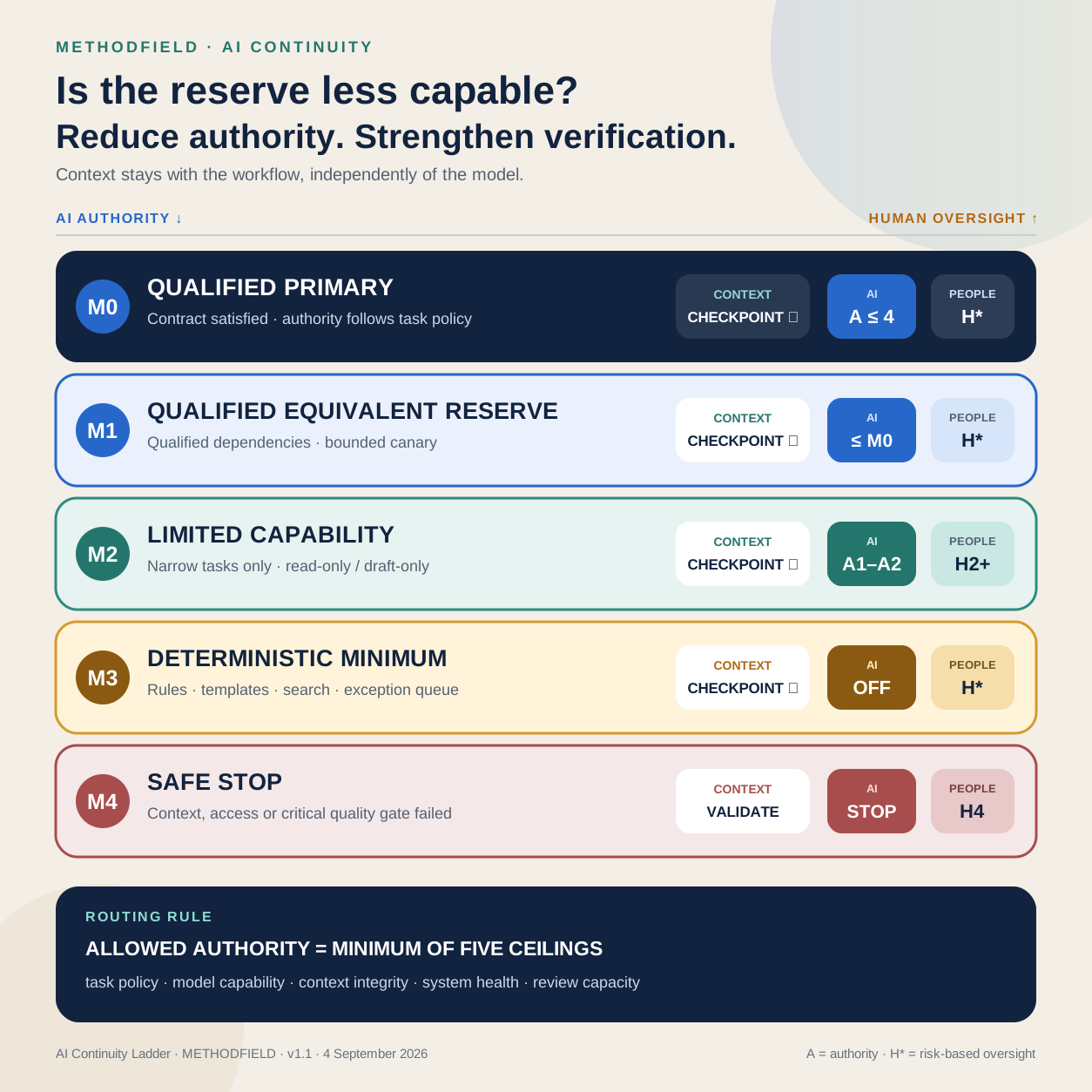
M0. Qualified primary
The primary configuration is healthy and passes current quality checks. Authority is the task's approved level, not the maximum possible autonomy. High-consequence actions may still need explicit human approval.
M1. Qualified equivalent reserve
The alternative has passed the agreed threshold for the same task family, languages, data policy and tools. Its failure dependencies are understood. Begin with a small canary, then increase traffic. Preserve or reduce authority according to evidence; switching providers never removes existing approvals.
M2. Limited capability
A cloud or self-hosted model passes only a narrower contract. It may extract, classify, summarise or draft, but does not inherit the primary's right to act. Consequential outputs require review before use. A model that can classify well is not automatically allowed to plan a complex release.
M2 describes capability for this task, not hosting location. A qualified internal model can be a primary or an equivalent reserve.
M3. Deterministic minimum
No suitable generative model is available. The service uses approved rules, templates, search, appropriately current cached material and conventional automation. Ambiguous work enters a queue. Users see the reduced service.
Human oversight follows the risk of the remaining action. A safe template does not automatically require two reviewers simply because the mode is M3.
M4. Safe stop
Context integrity, permissions or a critical quality condition fails. The system blocks new consequences and preserves evidence for an authorised recovery owner. Read access is permitted only if its own authorisation remains valid; otherwise the AI path is disabled.
The modes are not mandatory sequential steps. A permission failure or a critical constraint violation goes directly to a safe stop. Graceful degradation never means gradually relaxing safety boundaries.
Context belongs to the workflow
A Context Capsule is a compact, portable record of verified state. It is not hidden chain-of-thought and not an unlimited transcript.
Include:
- task ID, owner, objective and completion criteria;
- risk class and the policy version;
- verified facts with source references;
- decisions and their actual approvers;
- allowed data destinations and prohibited actions;
- completed tool calls, confirmed results and idempotency keys;
- artifact versions and hashes;
- open questions and the next safe action;
- previous model/configuration, operating mode and trace ID.
Durable workflow systems provide a useful architectural precedent. AWS Step Functions (opens in a new tab) maintains execution state and tracks data between steps. The portable principle is that the process owns state while the model performs a bounded operation.
Interoperability standards help at different layers: CloudEvents (opens in a new tab) for event structure, W3C Trace Context (opens in a new tab) for distributed trace propagation, OpenTelemetry (opens in a new tab) for telemetry conventions and MCP tools (opens in a new tab) for tool discovery and invocation. None of them defines your business decisions, permissions or verified facts for you.
Store intent before an external action and its confirmed outcome afterward. If execution succeeds but the result record is lost, reconcile with the system of record before retrying. A checkpoint alone does not prevent duplicates. Concurrent executors also need version checks, locks or fencing.
Treat retrieved text and model summaries as untrusted data. The authoritative permission policy must come from a trusted registry.
Cloud and internal models involve different trade-offs
An external model can supply useful capabilities without operating its infrastructure. It also creates dependencies on networking, identity, quotas, contracts and provider changes.
Self-hosting gives more control over versions and the data environment, but adds hardware capacity, security, patching, monitoring and staffing obligations. It does not automatically improve reliability or reduce quality.
Evaluate both on the actual task. One practical division of work might be:
- a qualified model for difficult analysis in an approved data environment;
- a specialised internal model for tested extraction or classification;
- deterministic software for calculations, validation, permissions and state;
- people for accountable decisions and exceptions.
An internal model becomes a reserve only after quality, load, cold-start and recovery tests. Different model names behind the same gateway, credentials, network or context store may still share a failure domain.
Route by capability and policy
Every task family needs a capability contract. Define quality, completeness, constraint adherence, tool correctness, language, evidence, latency, cost and data-processing requirements.
Test the primary and reserve on the same representative cases. Change one controlled layer at a time and repeat regression checks. Google Cloud's judge-evaluation guidance (opens in a new tab) compares model grading with human judgments. A model grader is useful, but should not become the only source of truth.
Services such as Amazon Bedrock intelligent prompt routing (opens in a new tab) illustrate request-level model selection. A router's supported models and optimisation criteria are not a replacement for an organisation's risk, authority and data policies.
The authority rule is:
Allowed Authority = min(
  Task Policy Ceiling,
  Model Capability Ceiling,
  Context Integrity Ceiling,
  Current Health Ceiling,
  Human Capacity Ceiling
)
The model cannot increase any ceiling. If mandatory reviewers are unavailable, queue, narrow or stop the work; do not bypass approval.
Make transitions controlled
Observe four signal families:
- Transport: timeouts, service errors, throttling, authentication failures and queue delay.
- Semantic: invalid output, unsupported claims, tool errors and quality regression.
- Context: missing checkpoints, stale versions, inaccessible sources or incomplete action history.
- Operational: consequences, reversibility, sensitive data and available review capacity.
Retries are for classified transient failures and safe-to-repeat operations. AWS retry guidance (opens in a new tab) recommends bounded attempts, backoff and jitter. Google SRE (opens in a new tab) describes how excessive retries amplify overload.
Use one retry budget across the chain. After the defined threshold, a circuit breaker blocks new calls to the failing dependency. Critical permission, integrity and policy failures stop the affected action immediately.
Return through probes, shadow comparisons and a small canary. Use a stability window and different entry/exit conditions so the system does not oscillate between models. Recovering an endpoint is not evidence that full authority is safe again.
Human review is a capacity, not a button
Reviewers need the proposed action, its consequence, supporting sources, changes made by the reserve, known limitations, previous actions and clear approve/edit/reject/stop controls.
The voluntary NIST AI RMF (opens in a new tab) provides a foundation for roles, measurement and risk response. Our practical extension is to treat reviewer capacity as an explicit continuity constraint.
Measure review arrivals, mean handling time, queue age and high-percentile delays. Add headroom for bursts and difficult cases. If the required capacity does not exist, reduce intake, prioritise or communicate delay. A thousand unread approvals are not human oversight.
Requirements for regulated or high-risk systems need a separate qualified legal, privacy and safety assessment. This framework does not determine legal classification.
Plan from the business impact
ISO 22301 (opens in a new tab) frames business continuity as a management system. NIST SP 800-34 (opens in a new tab) connects contingency planning with impact analysis.
For each AI-dependent workflow, define:
- the maximum tolerable disruption;
- RTO-AI: time to an acceptable, possibly reduced, operating mode;
- RPO-context: tolerable loss of confirmed state;
- minimum useful capacity during degradation;
- work that may queue and work that must stop;
- the owner of mode changes and user communications.
These AI-specific labels are Methodfield adaptations. They are not new requirements claimed to come from those standards.
A writing task may wait. A service workflow may use an approved acknowledgment and a human queue. A high-consequence software or business action may need to stop until its ordinary controls can be satisfied.
An incident runbook
Before an incident, agree the following sequence:
- Classify the failure and appoint an incident owner.
- Preserve checkpoints and suspend uncontrolled consequential actions.
- Apply the shared retry budget.
- Check the reserve's real dependencies, capacity and data approval.
- Transfer the Context Capsule and validate it.
- Test representative cases without unapproved external consequences.
- Select the permitted mode and review capacity.
- Tell users what is restricted and what happens to unfinished work.
- Restore gradually and reconcile pending or duplicate actions.
- Review the incident and add its failures to the evaluation set.
Test loss of quality, not only a disconnected endpoint
A continuity exercise should deliberately test a weaker executor, missing constraints and an overloaded human queue.
Principles of Chaos Engineering (opens in a new tab) starts with measurable expected behaviour and bounded failure experiments. AWS game-day guidance (opens in a new tab) emphasises exercising procedures with technical and business owners.
Test service errors, deadline overruns, exhausted quota, valid HTTP with invalid output, a critical fact lost during handoff, shared dependency failure and review overload. Start outside production. Any later production exercise needs an authorised scope, limited impact and a clear abort condition.
Continue individual work and software development
For manual AI use, keep a small handoff file outside the primary AI service: goal, constraints, decisions, verified sources, artifact links and next step.
When the model fails, first check what has already changed. Share only approved data with the reserve. Give it a narrow assignment.
For development, preserve the branch, diff, test results and unfinished work. Start with code explanation, tests or a draft patch. Do not automatically transfer permission to merge, deploy, change schemas or handle secrets. Ordinary review and release gates remain in force.
If the reserve cannot do the job, switch to documentation, manual analysis, testing or an agreed delay. Copying the whole chat into an arbitrary service is not a recovery plan.
A first 30-day exercise
Week 1: inventory critical AI-dependent work, owners, data, consequences and tolerable interruption.
Week 2: define representative evaluations, Context Capsules and idempotent action handling.
Week 3: prepare a qualified reserve or narrower model, deterministic minimum and a review queue with explicit limits.
Week 4: rehearse transport and quality failures. Measure useful completion, context loss, unsafe continuation, review load and restoration. Correct the findings before increasing authority.
This is a first bounded exercise, not a promise of a complete production implementation in 30 days.
The practical rule
The strongest model may disappear. Context, constraints and accountability must not disappear with it.
A reliable AI system knows what each executor can actually do, stores state outside the executor, reduces authority when evidence weakens and hands work to a person before the control boundary fails.
Use the AI Continuity Ladder playbook for the task classes, capability passport, Context Capsule example, oversight matrix, runbook and acceptance checklist.
Continue with AI Evaluation Operations, AI Agent Authority and post-launch ownership. Primary sources are linked beside the claims they support. Editorial and source review: 4 September 2026.
Sources
Primary sources are linked beside claims throughout the article. Key foundations: