
An AI system does not become finished when it starts working.
Customer language changes. Products, prices and policies change. Employees develop workarounds. Source documents become outdated. An API changes its behaviour or price. A model version changes. New exceptions appear only after the system meets normal volume.
If nobody owns these changes, a successful prototype becomes a fragile production dependency.
The practical question after launch is not only:
Is the system online?
It is:
Is the workflow still producing the intended business result, within its authority, quality, cost and risk boundaries?
The short answer
Every production AI workflow needs:
- a business owner for the outcome;
- an operational owner for daily use and exceptions;
- a technical owner for integrations, releases and recovery;
- a quality owner for evaluation and review;
- a documented authority boundary;
- business, workflow, AI-quality and technical measures;
- a change process;
- an incident path;
- a fallback and an exit plan.
In a small company, one person may hold several roles. The responsibilities must still be explicit.
Deployment changes the job
During a prototype, the team asks whether the system can perform a bounded task and whether the workflow is worth improving.
After launch, the job changes. The team must keep the whole socio-technical system reliable:
- people use the system consistently;
- data remains appropriate;
- rules and knowledge stay current;
- integrations continue to work;
- outputs remain within quality thresholds;
- uncertain cases reach the right person;
- costs remain acceptable;
- changes are tested before release;
- incidents can be contained and explained.
ISO/IEC 42001 treats AI as a management-system concern, covering policy, objectives, processes, risk and continual improvement. NIST similarly frames AI risk management as continuous: context, measures and responses should be revisited as systems and their environment change.
The practical implication is simple: an AI workflow is an operating system, not a one-time automation delivery.
Six ownership responsibilities
Business owner
Owns the outcome and decides whether the system remains worth operating.
Typical responsibilities:
- intended result and priority;
- acceptable business trade-offs;
- success and stop criteria;
- budget and operating cost;
- authority to expand, restrict or retire the system.
Operational owner
Owns the process as users experience it.
Typical responsibilities:
- current workflow and instructions;
- exception queue;
- user adoption and workarounds;
- feedback from staff and customers;
- business-rule changes;
- fallback operation.
Technical owner
Owns the application and integrations.
Typical responsibilities:
- releases and configuration;
- API and model dependencies;
- logging, alerts and tracing;
- access and secrets;
- backup, rollback and recovery;
- technical incident response.
Data and knowledge owner
Owns the inputs that make the system useful.
Typical responsibilities:
- source approval;
- access rights;
- freshness and versioning;
- retention and deletion;
- correction of outdated or conflicting material;
- provenance.
Quality owner
Owns the evaluation method, not the business decision.
Typical responsibilities:
- representative evaluation set;
- quality rubric;
- thresholds and review samples;
- subgroup and exception analysis;
- regression testing;
- evidence for release decisions.
Incident authority
Owns the decision to restrict, stop or restore the system during a material failure. This responsibility should be named before the first incident.
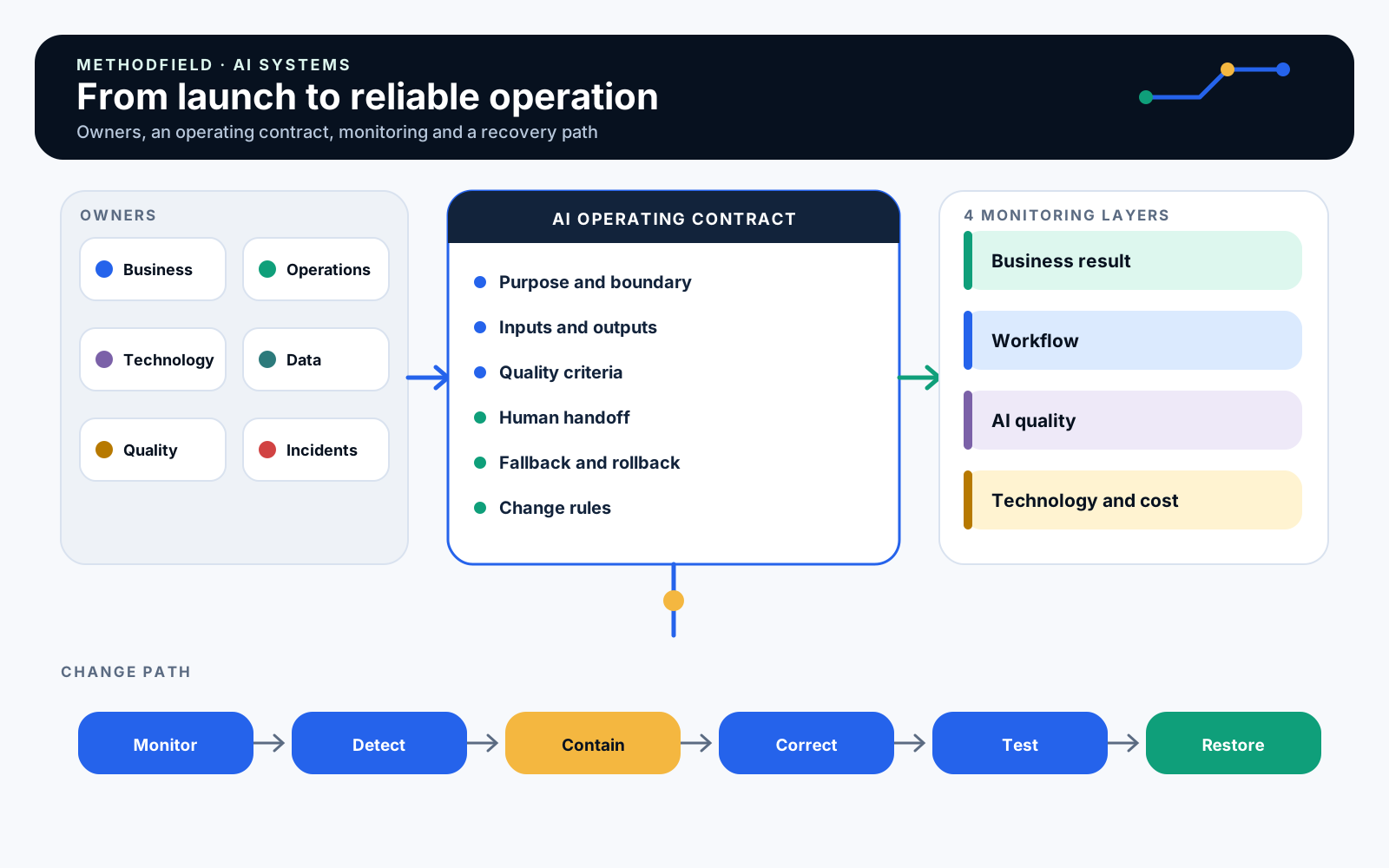
The AI Operating Contract
Create a one-page operating contract before launch. It is a Methodfield working tool, not a certification or a substitute for applicable legal and security requirements.
Purpose
- Which workflow does the system support?
- What business result should improve?
- Who is affected?
Boundary
- What inputs may the system use?
- Which actions may it prepare, recommend or execute?
- Which actions always require approval?
- Which cases must be escalated?
Ownership
- Who holds each of the six responsibilities?
- Who can approve a change?
- Who can stop and restore the workflow?
Measures
- Which business, process, quality and technical indicators are reviewed?
- What baseline and threshold apply?
- How often are they reviewed?
Evidence and logs
- Which input, output, source, decision and approval records are retained?
- How can a completed action be reconstructed?
- What must not be logged?
Fallback
- How does essential work continue without the AI provider or integration?
- What reduced service is acceptable?
- How are queued cases recovered?
Change and retirement
- Which changes require regression testing?
- What triggers a new risk or privacy review?
- When should the system be paused, redesigned or retired?
Monitor four layers
An uptime dashboard is not an operating model. Monitor at least four connected layers.
1. Business result
Examples:
- conversion to the agreed next step;
- avoided loss or rework;
- customer resolution;
- on-time completion;
- cost per verified outcome.
If the system remains technically healthy but the business result disappears, the workflow needs review.
2. Workflow performance
Examples:
- elapsed and employee touch time;
- incomplete cases;
- exception and escalation rate;
- corrections;
- backlog and abandonment;
- fallback usage.
These measures reveal whether AI has moved work rather than removed it.
3. AI quality
Examples:
- quality against a representative rubric;
- grounded or source-supported answers;
- instruction adherence;
- false positive and false negative consequences;
- uncertain outputs correctly escalated;
- performance on high-risk and edge cases.
Google Cloud and Microsoft guidance both treat continuous evaluation, production outputs, tracing and human review as parts of operational observability for AI applications. The exact platform is less important than the discipline: compare live behaviour with a defined expectation and connect failure to an owner and action.
4. Technical health and cost
Examples:
- availability and latency;
- error rate;
- failed tool calls;
- token and API cost;
- integration failures;
- version and configuration changes;
- security events.
Technical health explains whether the system can operate. It does not prove that the workflow remains useful or correct.
Define change events
Do not wait for a dashboard to deteriorate. Trigger a review when:
- a policy, product, price or service rule changes;
- a knowledge source is replaced;
- a model, prompt, tool or integration changes;
- a new customer group or language is added;
- the system receives a new permission;
- volume or case mix changes materially;
- the organisation changes the downstream process;
- a serious complaint, harmful output or security event occurs;
- the provider changes terms, retention or pricing.
Each event should identify the minimum regression tests and the person who can approve release.
An incident path for a small business
The incident process can be compact, but it should be explicit.
- Detect: alert, user report, quality sample or business metric identifies abnormal behaviour.
- Contain: restrict permissions, switch to draft-only mode, route all cases to review or activate fallback.
- Preserve evidence: retain the relevant version, input, output, tool call, approval and final action without exposing unnecessary personal data.
- Assess consequence: identify affected customers, records and downstream actions.
- Correct: repair the rule, source, prompt, integration or process.
- Test: run representative and incident-specific regression cases.
- Restore: release with an explicit approver and increased monitoring.
- Learn: update the operating contract, test set and prevention control.
The guide AI Agent Authority describes the permission envelope and recovery controls that limit an incident’s reach.
A practical operating rhythm
The cadence should match volume and consequence. A small workflow can begin with:
Continuous
- technical alerts;
- cost limits;
- high-consequence approval;
- explicit user reporting.
Weekly
- exceptions and corrections;
- unusual or uncertain cases;
- backlog and fallback use;
- recurring user workarounds.
Monthly
- business and workflow measures against baseline;
- representative quality sample;
- operating cost per verified outcome;
- source freshness and access review;
- prioritised improvements.
On every material change
- regression evaluation;
- authority and privacy review;
- rollback readiness;
- release approval.
The rhythm should become lighter when evidence shows stability, not when attention moves to the next project.
Design for replacement and exit
Reliable ownership includes the ability to leave a provider or retire the system.
Document:
- data and artifact export;
- source documents and business rules;
- prompts, evaluations and configuration;
- integration dependencies;
- manual fallback;
- retention and deletion obligations;
- customer and staff communication;
- the final owner of unresolved cases.
A workflow without an exit path may be technically convenient and operationally fragile.
How this connects to existing Methodfield content
From Observation to Action explains how evidence gates should precede greater authority. The operating contract keeps those gates active after launch.
Flexible Automation in a BANI World argues that resilience comes from the ability to detect change and safely reconfigure the process. Named ownership, change events and fallback make that ability operational.
Common ownership failures
- the developer owns uptime, but nobody owns the business outcome;
- the process owner cannot stop the system;
- reviewers correct outputs without recording why;
- the knowledge base has no freshness owner;
- model or prompt changes bypass regression tests;
- API cost is measured, but human review cost is not;
- fallback exists on paper but is never rehearsed;
- users create parallel workarounds that are invisible to monitoring;
- a successful pilot is left unchanged after the process around it changes.
Final position
Launching an AI workflow transfers work into a new operating system. It does not transfer responsibility to the model or vendor.
Name the outcome owner. Make exceptions visible. Monitor the complete workflow. Test material changes. Preserve a fallback and an exit.
That is how an AI feature becomes a reliable business system.
Sources
- ISO, ISO/IEC 42001:2023 — AI management systems (opens in a new tab), version available on 26 August 2026.
- NIST, AI Risk Management Framework Core (opens in a new tab), version available on 26 August 2026.
- NIST, Artificial Intelligence Risk Management Framework: Generative Artificial Intelligence Profile (opens in a new tab), published July 2024.
- Google Cloud, Deploy and operate generative AI applications (opens in a new tab), version available on 26 August 2026.
- Google Cloud, AI and ML perspective: Operational excellence (opens in a new tab), version available on 26 August 2026.
- Microsoft Learn, Observability in generative AI (opens in a new tab), version available on 26 August 2026.