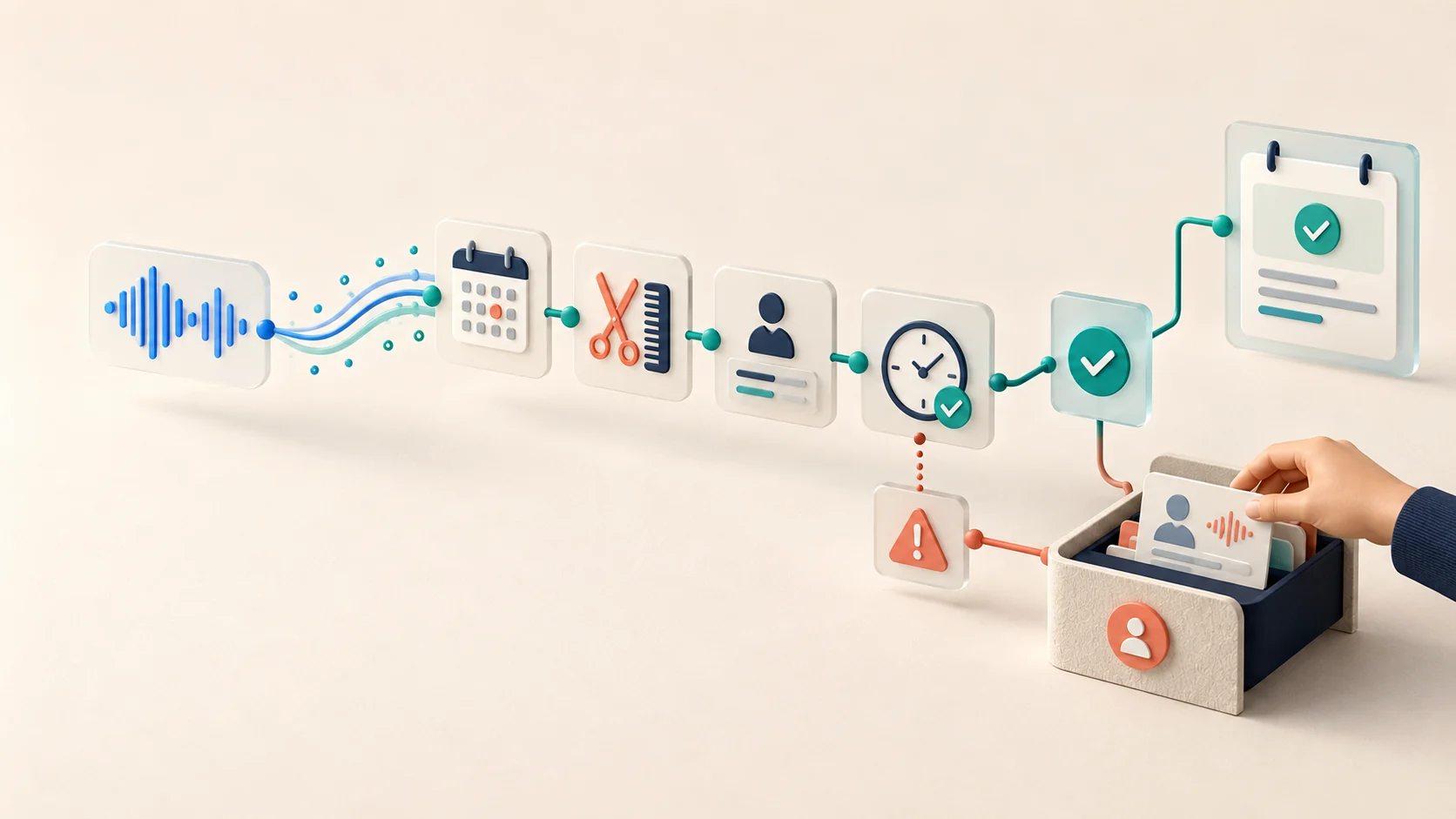
A voice assistant can sound natural in a vendor demonstration while placing the wrong appointment on a real calendar. Names, dates, interruptions, background noise and a customer's change of mind turn a simple call into a sequence of state changes. The launch question is not “Does it converse well?” It is “Can the service verify the booking and recover when the call goes wrong?”
Define the narrow job
Start with one intent, such as collecting an after-hours booking request. Specify whether the system may only capture details, propose slots or actually confirm an appointment. These are different authority levels. A request-capture pilot can be useful even when autonomous booking is not yet justified.
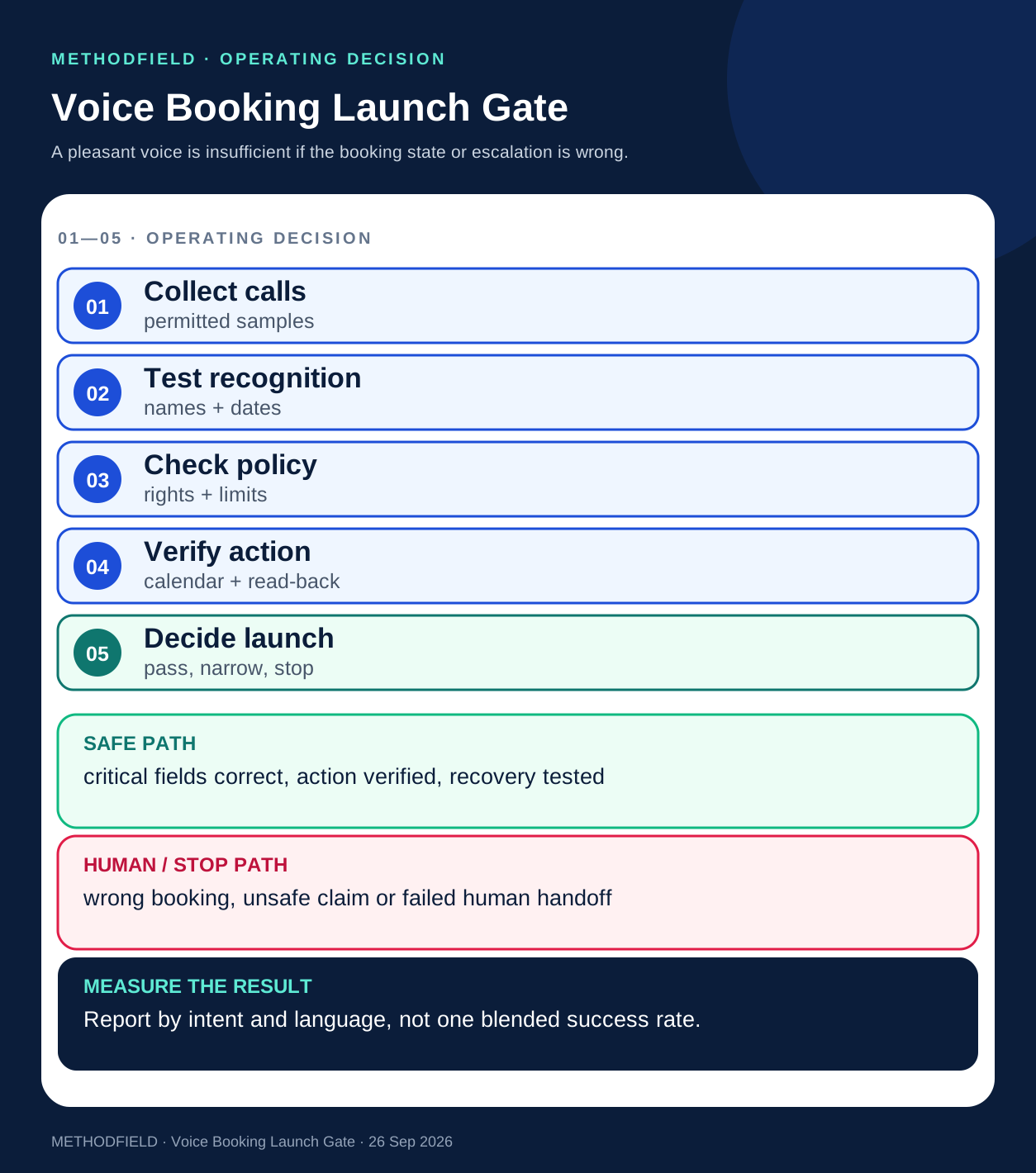
Prepare a test set from calls the organisation is allowed to use, supplemented with scripted difficult cases. Include accents and languages the service really receives, date ambiguity, similar customer names, interruptions, changed availability, cancellations, urgency and a caller asking for a person. Keep the original audio or an authorised transcript linked to the expected result so a reviewer can inspect failures.
Test the whole action
Speech recognition is only the first layer. Check whether the system extracted the right service, date, timezone, location, contact and constraints. Where an existing booking or account is changed, check identity and authority; for a new booking, collect only the details the service actually requires. Then verify that a proposed slot was live, a confirmation was repeated back accurately, the calendar returned an ID and the customer received the same details. Finally test a failed write, a dropped call and a human transfer with complete context.
Critical errors need explicit no-go rules. A wrong customer's booking, a confirmed slot without a calendar record or a failure to hand off a sensitive request should block autonomous confirmation even if most ordinary calls sound excellent. Less serious defects can lead to a narrower launch: capture requests and send them to staff rather than book automatically.
Example: two calls with the same opening
Both callers say, “I need an appointment next Thursday.” One has a standard service and a clear account; the assistant can offer available times. The other later mentions an urgent safety concern. That call should leave the booking script and reach the responsible person. The difference is not voice quality. It is intent and consequence. This example is illustrative, not an observed customer result.
Make a launch record
For each case, record language and intent, expected action, actual transcript, field accuracy, policy outcome, calendar transaction ID, customer-facing confirmation, reviewer decision and recovery time. Report by language and intent; a blended pass rate can conceal failure in a smaller market. Include human workload created by corrections and escalations, not only calls deflected.
Use three outcomes: launch the tested narrow intent, launch in request-capture mode, or stop and repair the process. Set an owner for every outcome and a date for re-evaluation. Voice should not inherit permission to change a booking merely because text triage works.
This continues Methodfield's multilingual service desk, which recommends text and drafts before voice. The evaluation operations guide gives the general release framework; this article turns it into a booking-specific voice gate.
Working artifact: a voice launch gate
Keep a separate result for each language and call intent. A general average must not conceal a failure in the exact route being released.
| Gate | Evidence required |
|---|---|
| Understanding | Correct service, date, timezone and constraints in test calls |
| Authority | Identity checked when changing an existing record; action in scope |
| Commitment | Live slot, accurate read-back, calendar ID and matching message |
| Recovery | Failed write, interruption and human transfer tested end to end |
| Decision | Named owner chooses confirm, capture-only or no launch |
Review every critical failure individually. If one language has too few cases to support autonomous confirmation, release that language in capture-only mode while collecting more authorised examples. The decision remains specific to the tested service and channel.
Sources and scope
Recording, disclosure, privacy and service requirements require review for the actual channel and market before launch.