A small European business can acquire customers across several countries long before it can afford a support team for every language and time zone.
The operational symptoms are familiar. Email waits until somebody who knows the language is available. A service adviser answers the same delivery or booking question for the fifth time that day. The website chatbot covers a narrow FAQ but loses the conversation as soon as an order, contract or exception is involved. Phone calls outside business hours become missed revenue or frustrated customers.
Generative AI appears to offer one immediate answer: connect every channel to a multilingual agent and make it available 24/7.
That is an attractive interface and an incomplete operating model.
A useful AI service desk is not one bot pretending to be a complete support department. It is a routing and evidence system. It identifies the customer and language, classifies the intent and risk, retrieves current information, proposes or delivers an answer within a defined authority, and passes the full context to a person when the boundary is reached.
For most SMEs, the safest path starts with email triage and reply drafts. It progresses to grounded self-service for a narrow set of intents. Voice comes later, after the business has enough transcripts, exception data and handoff discipline to know what the agent should and should not do.
Europe turns language into an operating-system problem
Multilingual service is often treated as a translation requirement. In practice it combines at least five problems:
- Language detection: what language is the customer using, and do they switch during the conversation?
- Intent recognition: is this a general question, a booking change, a complaint, a payment issue or a safety concern?
- Business context: which customer, order, property, vehicle, subscription or case is involved?
- Knowledge retrieval: which policy, availability record, contract term or troubleshooting step is current and applicable?
- Authority: may the system answer, propose an action, execute it, or must it escalate?
A good translation with the wrong delivery policy is still a bad answer. A grammatically fluent voice agent that modifies the wrong booking is worse.
The design unit should therefore be the complete service decision, not the translated sentence.
Do not optimise for deflection alone
Contact deflection — the share of requests resolved without a person — is easy to place on a dashboard. Maximising it can create perverse behaviour. The system may keep a customer inside a failing loop, classify an exception as routine, or give a generic answer when a person could resolve the issue quickly.
The business outcome is closer to appropriate resolution at the lowest responsible level:
- a routine question receives a fast, correct answer;
- a simple authenticated change is completed within policy;
- an ambiguous request is clarified;
- a consequential or emotional case reaches a person early;
- the person receives the conversation, evidence and proposed next step;
- the customer does not have to start again.
This is consistent with the workflow-before-agent pattern: deterministic systems control identity and action, AI interprets language, and a person owns the boundary of consequence.
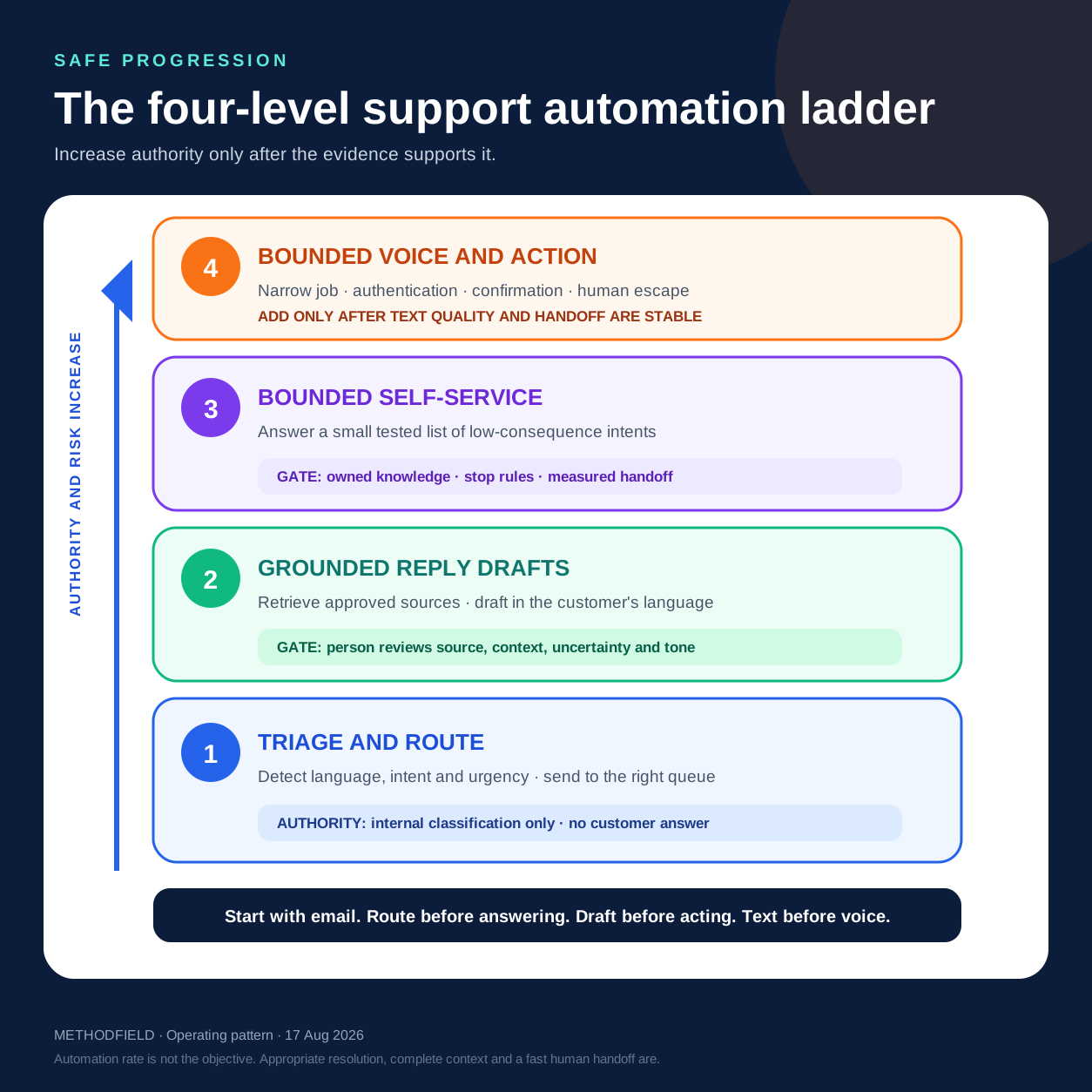
The four-level automation ladder
Level 1: triage and routing
The system detects language, classifies intent, identifies urgency, extracts references such as an order number and sends the request to the correct queue. It may summarise a long email for the agent.
It does not answer the customer.
This level has modest technical glamour and high practical value. It reduces queue switching, exposes demand by language and produces the labelled history needed for later automation.
Level 2: grounded reply drafts
The system retrieves approved knowledge and prepares a response in the customer's language. A person reviews and sends it.
The reviewer should see:
- the original message;
- detected language and intent;
- customer and transaction context;
- sources used;
- proposed answer;
- uncertainty or missing information;
- a simple approve, edit, redirect or reject choice.
Edits are training data for the process, even when they are not used to train a model. They reveal missing knowledge, poor routing and risky intents.
Level 3: bounded self-service
The system may answer without pre-approval for a small list of tested intents, for example:
- opening hours and location;
- delivery tracking from an authoritative system;
- product compatibility based on maintained attributes;
- resending an existing document to an authenticated customer;
- booking availability without commitment;
- standard troubleshooting with a safe stop condition.
Each intent needs an owner, source, expiry rule, escalation condition and quality metric. “Anything in the FAQ” is not a sufficient boundary.
Level 4: bounded voice and transactional service
Voice adds latency, recognition, interruption, accent and emotional-tone problems. It also increases the cost of a bad handoff because the customer cannot inspect the answer before acting.
A voice agent should begin with a narrow job: after-hours information, call qualification, booking requests, status checks or message capture. Transactional actions require authentication, confirmation and an explicit read-back of important details.
Do not move to this level simply because a vendor demo sounds natural. Move when the earlier levels have produced stable intents, reliable knowledge and a measured escalation process.
What the European SME cases show
RIS d.o.o.: support augmentation with measurable pilot results
RIS d.o.o. is a Croatian business-software SME with 10–49 employees. Its support team faced repetitive email and phone questions, delayed resolution of complex issues and no 24/7 availability.
Through an EDIH Adria “test before invest” project, the company piloted a support assistant using retrieval-augmented generation. The system combined a curated knowledge base of FAQs, manuals and past interactions with:
- automatic email classification and prioritisation;
- search across internal documentation;
- AI-generated reply drafts for review;
- a dashboard and interaction history;
- mailbox integration;
- a security-conscious architecture.
The European Digital Innovation Hubs Network reports an estimated 50–60% reduction in manual support workload, responses to standard queries more than 70% faster, up to 40% fewer escalations to senior staff and 24/7 availability without new hires.
The page describes pilot results and uses estimated language for part of the impact. It is not an independent longitudinal audit. The operational pattern is nevertheless strong: start with triage, retrieval and drafts inside the existing mailbox process; keep human oversight; learn from exceptions before expanding authority.
Adria P.A.: multilingual and voice capability as a staged choice
Adria P.A., a small Croatian Renault and Dacia dealership, explored AI support for peak periods and out-of-hours enquiries. EDIH Adria compared a ready-made chatbot platform with a more adaptable open-source RAG approach. The company selected the latter for flexibility, multilingual communication, voice integration and budget fit.
At the time of the published case, implementation was still in progress and the cost and conversion improvements were projections, not achieved outcomes. Use this case for its architecture and selection logic, not as ROI proof.
That distinction matters. A pilot can demonstrate technical feasibility without proving customer acceptance, maintenance cost or commercial return.
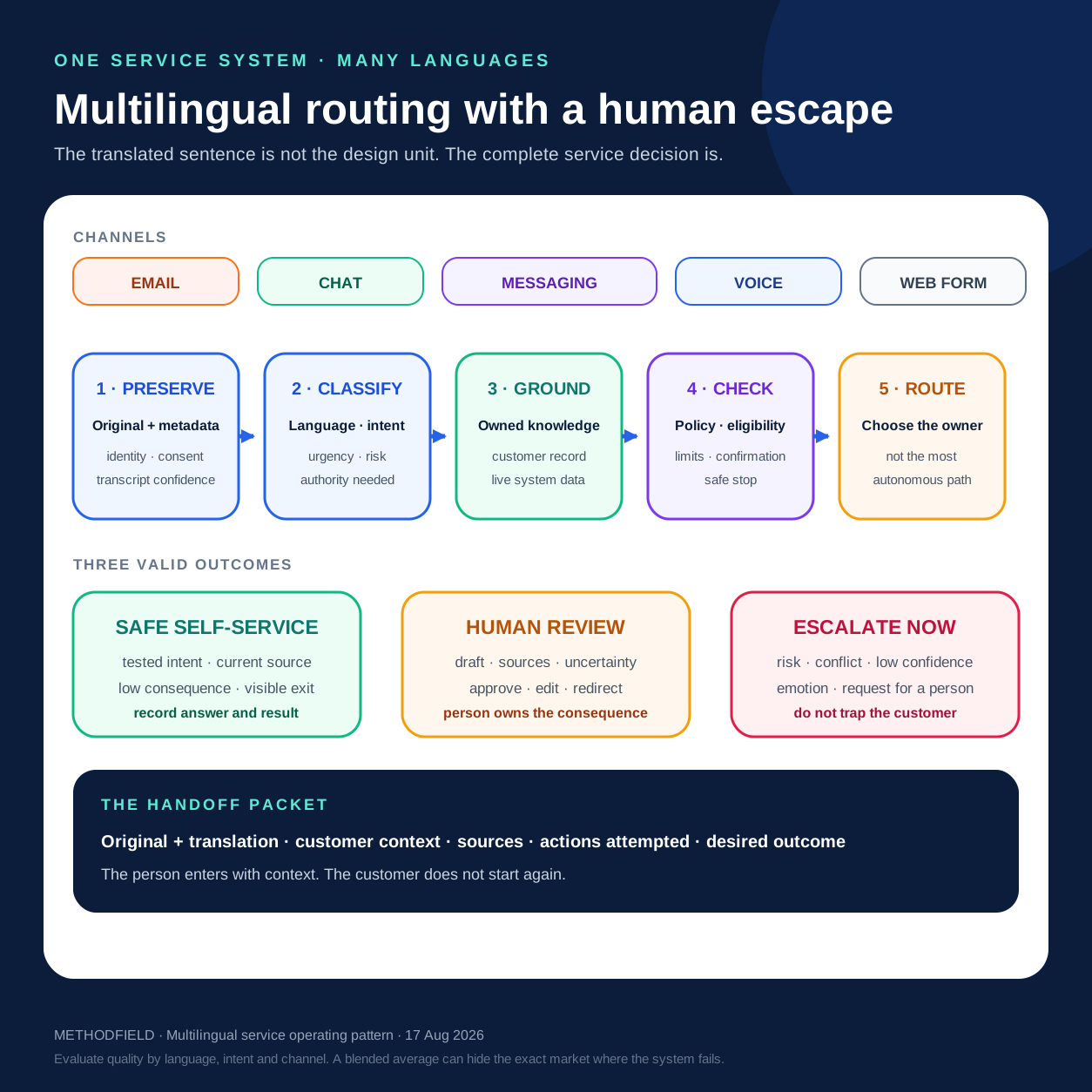
The multilingual service routing model
1. Capture the channel event and preserve the original
Email, chat, messaging and voice should enter a shared case model. Preserve the original message or recording reference, timestamp, channel, customer identifier and consent metadata.
For voice, store a transcript linked to the audio according to the applicable retention policy. Low-confidence transcription should be visible; it must not silently become a reliable fact.
2. Resolve identity before exposing private context
An anonymous visitor can ask about opening hours. They should not receive order details, change a reservation or access account documents.
Authentication and authorization belong outside the language model. The model may explain the next verification step; it should not invent or bypass it.
3. Detect language, intent and risk separately
Language does not determine risk. A request may begin as a routine status question and become a complaint, cancellation or safety issue.
Maintain separate labels for:
- language and locale;
- intent;
- urgency;
- emotional or vulnerability signal where appropriate and lawful;
- financial, contractual, health, safety or personal-data risk;
- required authority level.
If confidence is low, ask a clarifying question or route to a person. Do not use confidence as a licence to guess.
4. Retrieve from approved, scoped knowledge
Build the knowledge base around decisions, not around file storage. A useful entry includes:
- the customer question it answers;
- countries, products or customer types to which it applies;
- owner and approval date;
- source policy or system;
- effective and expiry dates;
- escalation conditions;
- approved examples and prohibited claims.
Separate stable public knowledge from authenticated customer data and live operational records. A policy page cannot answer whether this customer's parcel left the warehouse; the order system can.
5. Generate in the right language with controlled terminology
There are two common patterns:
- translate the request into a working language, reason and retrieve there, then translate the response;
- retrieve and generate directly in the customer's language.
Neither is universally superior. Test by intent and language. Direct generation may preserve tone and reduce translation steps; a pivot language may make quality control and knowledge maintenance easier for a small team.
Whichever pattern you use, maintain glossaries for product names, contract terms, safety language, units, place names and phrases that must not be softened. Review languages with low traffic or limited model quality more conservatively.
6. Apply policy before action
The model may propose a booking change, refund, replacement or account update. Deterministic rules should verify eligibility, limits, inventory, deadlines and authority before the action is offered.
For consequential changes, display the exact proposed action and ask the customer or employee to confirm it. Execute through a normal API and record the returned result.
7. Hand off the complete case
An escalation bundle should contain:
- original and translated conversation;
- authenticated customer and transaction context;
- detected intent and risk;
- knowledge sources already consulted;
- actions attempted and their results;
- a concise summary;
- the customer's requested outcome;
- the reason for escalation.
The agent should enter the conversation with context, not ask the customer to retell the story.
8. Learn from resolution, not only from model output
Capture why the case was edited, reopened or escalated:
- wrong language or tone;
- outdated knowledge;
- unsupported claim;
- missing customer context;
- failed authentication;
- policy boundary;
- system integration failure;
- customer explicitly requested a person;
- emotional or complex complaint.
Use recurring patterns to update knowledge, routing, rules and product design. Do not solve every defect by appending another sentence to one large prompt.
Design the knowledge base as a product
The knowledge base is usually the limiting factor, not the model.
A practical ownership model assigns every high-volume intent to a business owner. Support may own delivery questions, finance may own invoice and refund language, operations may own booking constraints, and legal may approve specific contractual wording.
Set review intervals based on volatility:
- live availability and status come from systems of record;
- prices and delivery windows may need daily or weekly synchronization;
- policies require review when the business changes them;
- regulated or safety content needs explicit approval and version history;
- evergreen troubleshooting still needs an owner and feedback loop.
Test answers against realistic variants, spelling errors, code-switching and incomplete questions. A multilingual system should be evaluated by language and intent, not through one blended average.
Disclosure, privacy and recording are workflow requirements
The existing METHODFIELD guide to EU AI transparency for small businesses covers customer-facing disclosure in detail. The service desk should implement that decision operationally: identify where a customer interacts directly with AI, provide the required information at the correct moment and retain evidence that the disclosure was active.
Privacy and recording rules vary by country, channel and purpose. Before processing calls or messages, define:
- lawful purpose and data minimisation;
- whether and how recording consent or notice is required;
- retention for audio, transcripts and derived summaries;
- access to sensitive customer data;
- model-provider and subprocessor roles;
- rules for using conversations in evaluation or training;
- deletion, export and correction processes;
- a non-AI service route where required or appropriate.
“The model supports European hosting” does not complete this work. The business process, contracts, configuration and employee access all matter.
A 30-day pilot
Week 1: map demand and choose one language pair
Sample 100 recent contacts. Label channel, language, intent, handling time, resolution, escalation and missing knowledge. Choose one high-volume, low-consequence intent and one additional language.
Establish the baseline before automation.
Week 2: launch triage and drafts in shadow mode
Detect language and intent, retrieve sources and generate reply drafts without sending them. Compare with the actual agent response. Track unsupported statements, tone corrections and routing errors.
Week 3: use reviewed drafts live
Let a small group review and send proposals. Present sources and context in the review interface. Measure total handling time, not only generation speed.
Week 4: automate one safe intent
Enable direct answers for a narrow, tested intent. Keep a visible route to a person and stop after repeated misunderstanding, low retrieval confidence or an explicit request for human help.
Do not add voice until text channels show stable knowledge and handoff performance.
Metrics that balance efficiency and trust
Access and speed
- first response time by language and channel;
- after-hours contacts successfully handled;
- waiting time before human pickup;
- language coverage.
Resolution
- first-contact resolution;
- repeat contact within seven days;
- reopen rate;
- appropriate self-service rate;
- escalation rate by intent and language.
Quality
- replies accepted without edit;
- material factual or policy error rate;
- unsupported-claim rate;
- translation and terminology defects;
- customer correction rate;
- handoffs with complete context.
Economics
- human handling minutes removed;
- review minutes added;
- platform and model cost per resolved contact;
- cost per language supported;
- missed booking, lead or renewal recovered, with cautious attribution.
Human experience
- customer satisfaction by channel and language;
- employee trust in drafts;
- queue-switching and after-hours burden;
- percentage of escalations that arrived at the correct owner.
A higher automation rate is not a success if repeat contacts, complaints or employee checking effort increase.
Questions to ask before buying a multilingual agent
- Can performance be measured separately by language, intent and channel?
- How does the system show the source for an answer?
- Can each intent have its own tools, authority and escalation rules?
- What happens when language, transcription or retrieval confidence is low?
- Can a person see the original message and translation side by side?
- How are glossaries, policy versions and effective dates managed?
- Which actions require authentication and confirmation?
- Can the system prevent duplicate bookings, messages or refunds after a retry?
- How quickly can a customer reach a person?
- What context is transferred during handoff?
- Where are audio, transcripts and derived data stored, and for how long?
- Can the business export conversations, decisions, evaluations and audit events?
The practical rule
Begin with the channel where mistakes are easiest to inspect: email. Automate routing before response, drafts before autonomous answers, and text before voice. Ground every answer in owned knowledge or a system of record. Keep identity, policy and execution outside the language model. Escalate with context.
The goal is not to make a small team look like a giant call centre. It is to let a small team serve more customers and languages without hiding uncertainty or losing the human relationship when it matters.
References
- European Digital Innovation Hubs: AI-powered digital assistant for RIS d.o.o. (opens in a new tab)
- European Digital Innovation Hubs: Adria P.A. AI assistant (opens in a new tab)
- European Digital Innovation Hubs: success-story evidence guidelines (opens in a new tab)
- Microsoft customer story: Riverty's AI-ready contact-centre foundation (opens in a new tab)
- DeepL: customer-support language AI overview (opens in a new tab)
This article provides operational guidance, not legal advice. Confirm the privacy, recording, consumer-protection and AI-transparency requirements that apply to each country, channel and use case before deployment.