
For years, small-business finance automation began with a document: a PDF arrived by email, somebody typed its fields into accounting software, and a rule or OCR tool tried to remove a few keystrokes.
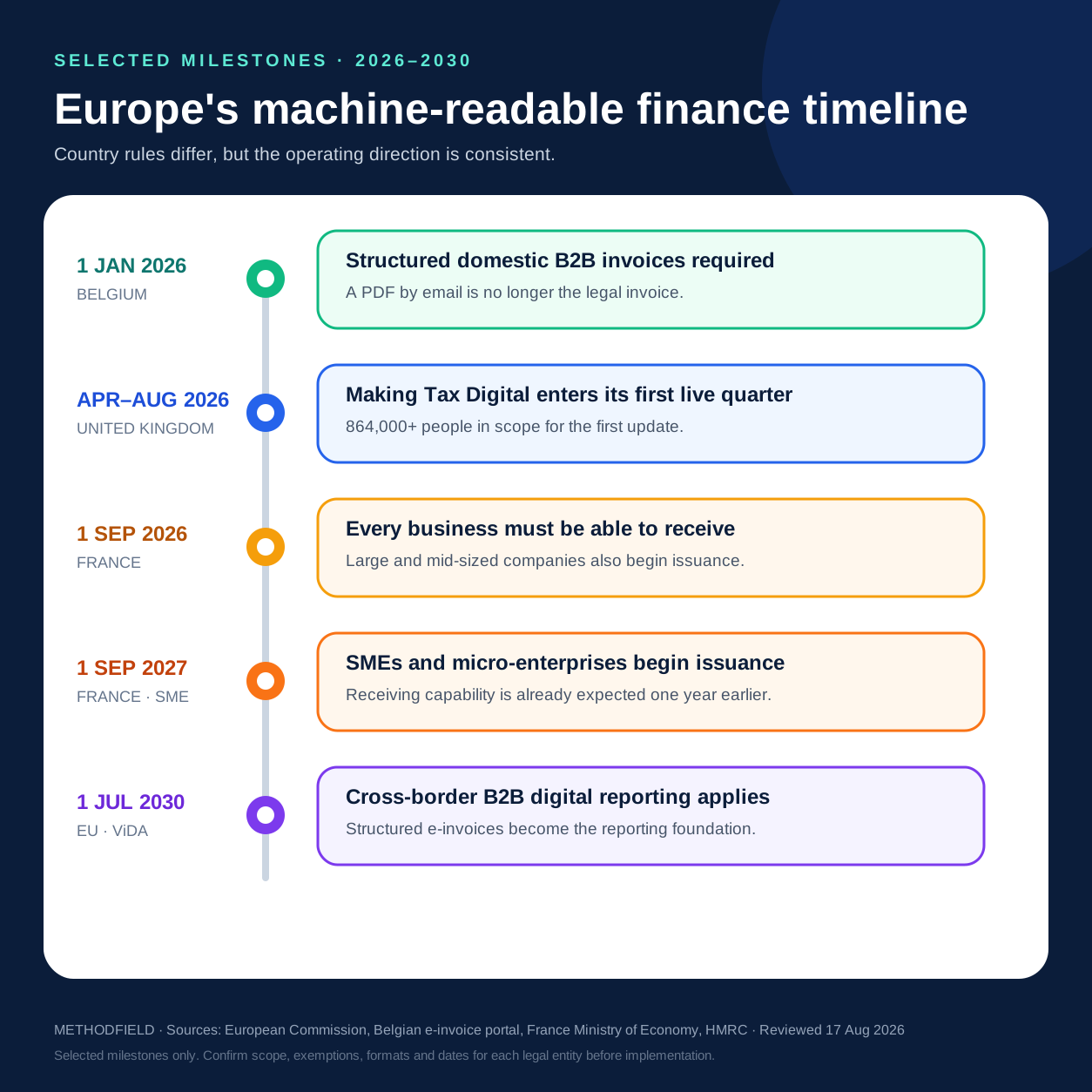
Europe is changing the starting point. A growing share of invoices will arrive as structured data that software can receive, validate and process directly. Belgium already requires structured electronic invoices for almost all domestic VAT-registered B2B transactions. France is approaching the first phase of a reform that will require every business to receive electronic invoices. The United Kingdom has moved a large group of sole traders and landlords into quarterly digital reporting. At EU level, VAT in the Digital Age is creating a longer path toward cross-border digital reporting based on e-invoicing.
This is a much bigger opportunity than “scan invoices faster.” It makes finance a sequence of machine-readable events.
It also creates a new risk. If a business inserts generative AI into that sequence without clear controls, the system may produce a confident category, tax treatment or payment recommendation that nobody can reconstruct later. Finance cannot operate on plausible answers. It needs evidence, authority and a record of what happened.
The useful design is therefore not an autonomous AI accountant. It is an audit-ready workflow in which deterministic software checks what must be exact, AI interprets what is genuinely ambiguous, and a person owns material exceptions and approvals.
Why this is an operational issue now
The European timetable is not one uniform mandate. Each jurisdiction has its own scope, formats, platforms, exemptions and transition rules. The direction, however, is consistent: invoices are becoming structured records exchanged between systems rather than visual documents exchanged between inboxes.
Belgium: structured B2B invoices are already required
Since 1 January 2026, structured electronic invoicing has been compulsory for almost all transactions between Belgian VAT-registered businesses. The official Belgian guidance is explicit that emailing a PDF is no longer sufficient. The structured invoice is exchanged through connected software, normally via the Peppol network.
The obligation also reaches many very small businesses. A company using Belgium's small-business VAT exemption may still fall within the e-invoicing requirement. That makes readiness a workflow question, not only an enterprise ERP project.
France: every business must be able to receive
From 1 September 2026, all businesses established in France must be able to receive electronic invoices through an approved platform. Large and mid-sized businesses also begin issuing electronic invoices at that point. SMEs and micro-enterprises move to mandatory issuance from 1 September 2027.
The French Ministry of the Economy says the reform concerns more than ten million economic actors. For a small supplier, the near-term task may be receiving correctly. For a small buyer serving larger companies, the commercial pressure to issue compatible invoices may arrive before the formal SME deadline.
The ministry now also describes the September launch as a start-up phase with an administrative approach of support and tolerance for businesses that encounter difficulties. That does not move the statutory dates or remove the need to prepare. It does mean an implementation plan should distinguish the legal timetable from the way early operational problems may be handled.
United Kingdom: digital records become a recurring operating rhythm
Making Tax Digital for Income Tax became mandatory in April 2026 for sole traders and landlords with qualifying income above £50,000. More than 864,000 people were in scope for the first quarterly update due on 7 August 2026. The threshold falls to £30,000 from April 2027 and £20,000 from April 2028.
HMRC says no penalty points will be issued for late quarterly updates during the first year, although taxpayers remain responsible for accurate records and the usual return and payment deadlines still apply.
The UK is outside the EU, but it is part of the European operating landscape for many businesses. Its experience is useful because it shows the behavioural change created by digital reporting: records need to be maintained throughout the quarter, not reconstructed at year-end.
EU ViDA: the cross-border direction is set
The VAT in the Digital Age package was adopted in March 2025 and will be implemented in stages. Digital reporting requirements for cross-border B2B transactions are due to apply from 1 July 2030, based on structured electronic invoices. National systems can move earlier, as Belgium and France demonstrate.
This article is not a substitute for country-specific tax advice. Its purpose is to show the operating model that becomes possible — and necessary — when finance data is structured.
A structured invoice is not an automated process
A structured invoice can make fields machine-readable: supplier identity, invoice number, dates, line items, VAT information, payment terms and totals. That removes one source of manual transcription. It does not answer every business question.
The system still needs to determine:
- whether the supplier is the expected legal entity;
- whether this invoice has already been received through another channel;
- whether a purchase order or delivery record exists;
- whether the price and quantity match the agreement;
- whether the VAT treatment is consistent with the transaction;
- who has authority to approve the cost;
- whether the bank details changed unexpectedly;
- whether a credit note or dispute affects payment;
- which accounting period and cost centre should receive the entry.
Some of those checks are exact. Some require contextual interpretation. Some are decisions with financial consequences. Treating all three as “an AI task” is the design mistake.
Divide the work by the kind of certainty it requires
Deterministic controls handle exact conditions
Use ordinary software, rules and trusted registries when the answer should be reproducible:
- validate required fields and document format;
- verify totals and tax arithmetic;
- detect a duplicate invoice number for the same supplier;
- compare line items with an approved purchase order;
- compare bank details with the supplier master record;
- enforce approval limits and separation of duties;
- prevent payment before required approvals;
- write an immutable event to the audit log;
- submit data through the approved country-specific channel.
For the same input and rule version, these controls should produce the same result.
Bounded AI interprets ambiguous material
AI can help where language or classification varies:
- suggest a ledger account from the line description and past approved entries;
- identify an unclear service period in a supporting document;
- summarise why a three-way match failed;
- group recurring exceptions for process improvement;
- draft a supplier query about missing evidence;
- explain a cash-flow anomaly using linked transactions;
- propose, but not silently apply, a category for a new type of expense.
The output should be structured, confidence-aware and linked to the source evidence. “Office services” without the supporting line item, model version and approval record is not an audit-ready result.
People own authority and material exceptions
A person should approve or resolve:
- new suppliers and bank-detail changes;
- invoices above an authority threshold;
- tax treatments outside a pre-approved ruleset;
- contract or delivery disputes;
- related-party or unusual transactions;
- payments released after a control warning;
- corrections to a closed reporting period;
- any case where the evidence conflicts.
Human review is not a decorative button. The reviewer needs the source document, extracted fields, validation results, proposed action, uncertainty and change history in one place.
The audit-ready invoice workflow
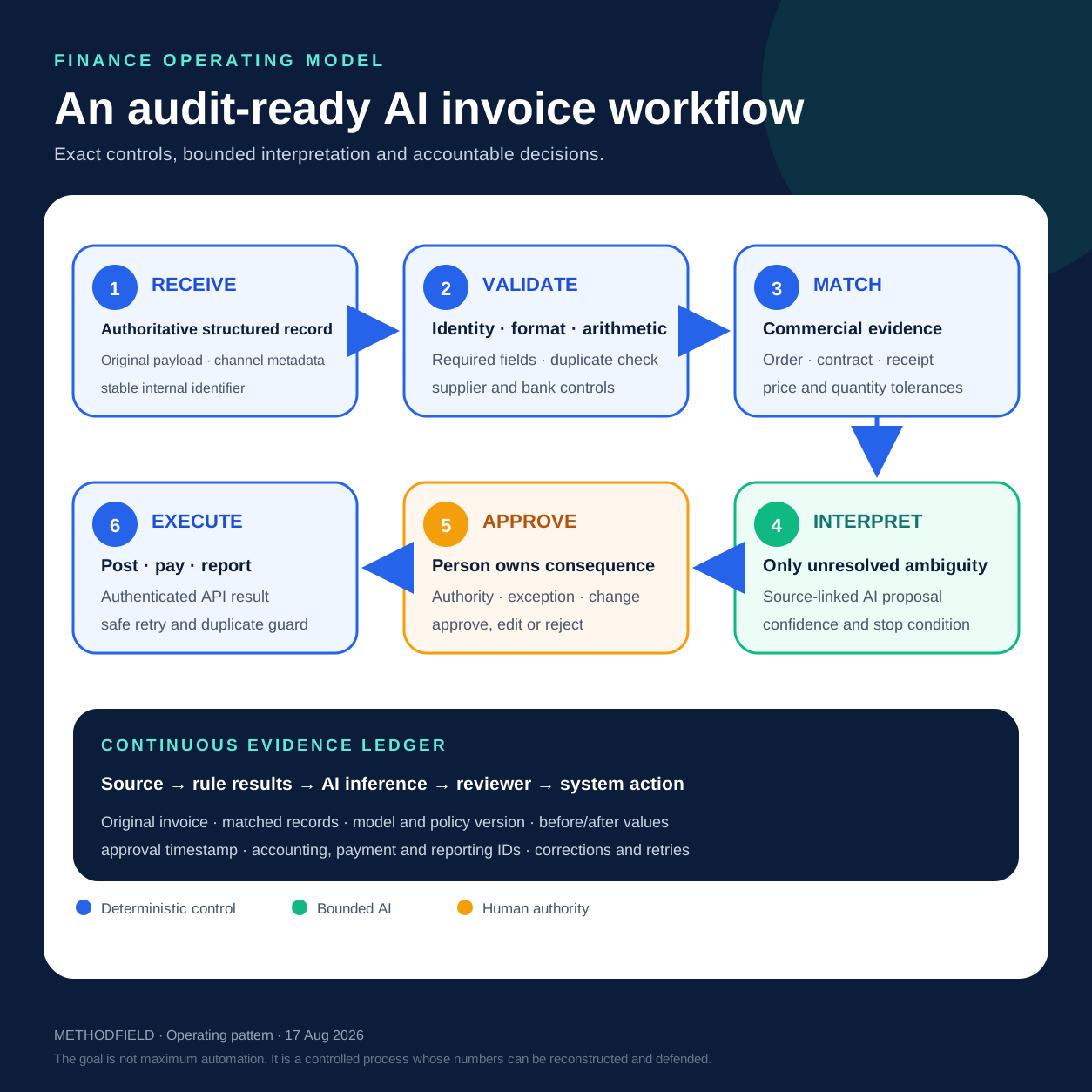
1. Receive one authoritative record
Accept the invoice through the required network or approved platform. If a courtesy PDF also arrives by email, link it to the structured invoice instead of creating a second payable item.
Assign a stable internal identifier. Store the original payload and relevant transmission metadata before transforming anything.
2. Validate identity, structure and arithmetic
Check that required fields exist, the format is supported, the supplier identity can be resolved, totals reconcile and the document has not already been processed.
Do not ask a language model to add numbers that normal code can add exactly.
3. Match the commercial evidence
Connect the invoice to the purchase order, contract, goods receipt, delivery confirmation or approved recurring agreement. Define tolerances for price, quantity and timing.
A clean match can continue automatically. A mismatch should become a visible exception with a reason code.
4. Use AI only for the unresolved interpretation
If the line description is vague, supporting documents are unstructured or the mismatch needs explanation, allow AI to propose a classification or summary. Supply only the material needed for that task and require references back to the evidence.
This follows the same principle as building the workflow before the agent: the model is one bounded component, not the owner of the transaction.
5. Route by authority and risk
Low-value, known-supplier invoices with a complete match may be posted under a pre-approved policy. Exceptions go to the correct owner based on amount, cost centre, supplier and exception type.
Avoid a generic finance inbox. Routing is part of the control system.
6. Approve the proposed accounting treatment
Show the reviewer what is being approved: supplier, amount, due date, account, tax code, cost centre, match status and any AI-derived field. Display the previous value when a master record or coding decision changes.
7. Post, pay and report through deterministic actions
After approval, use authenticated APIs or accounting-system functions to create the entry, schedule payment and update the required reporting records. Capture returned transaction IDs. The AI should not “assume” that an action succeeded.
8. Preserve the evidence ledger
For every material event, retain:
- original invoice and transmission metadata;
- normalized fields and validation results;
- matched business records;
- model, prompt or policy version for AI-derived proposals;
- reviewer, timestamp and decision;
- before-and-after values;
- downstream accounting, payment and reporting IDs;
- corrections, reversals and retry history.
The retention period and lawful basis depend on jurisdiction and document type. The operating rule is simpler: do not discard the evidence needed to explain a posted number.
The hidden cost of black-box finance AI
Sage and IDC reported in 2026 that 71% of surveyed finance leaders would reject an AI system that could not fully explain its output. The study says the average finance professional spent almost 13 hours per week reconstructing, validating and defending AI outputs, losing 26% of the time savings AI created.
This is vendor-sponsored research and should be treated as such. The concept is still useful: automation can create a trust cost. A system saves five minutes at entry and then consumes ten minutes when a reviewer must discover where the number came from.
The answer is not a longer generated explanation. It is data lineage:
- which source supplied the fact;
- which deterministic rules passed or failed;
- what the AI inferred rather than observed;
- who accepted the inference;
- what action the accounting system actually completed.
That is an operational extension of the AI quality layer: quality is not only whether the model produced a plausible answer, but whether the business can safely use and defend it.
What current small-business cases actually show
Tyne Chease: time returned to the operating team
In a Sage customer story, UK plant-based food producer Tyne Chease says Sage Copilot automated invoice chasing and daily financial administration, saving 12–14 hours per week. The company linked the regained capacity to audit preparation, cost review and readiness for larger retail opportunities.
The result is vendor-published and not independently audited. Its transferable lesson is that finance automation creates value when it releases a named bottleneck and the team reinvests the time in growth or control work.
M.O.E.: deterministic automation before generative AI
The European Digital Innovation Hubs Network describes a German SME that automated a repetitive DATEV document-upload process. The workflow reportedly fell from one to two hours per upload, performed twice a week, to roughly ten minutes.
That case used robotic process automation, not a generative agent. It is a useful counterweight to AI enthusiasm: if the task is stable clicking, moving and checking, conventional automation may be cheaper to verify and easier to maintain.
A 30-day pilot for an SME
Week 1: choose one invoice population and measure it
Select one legal entity, one country and one predictable invoice class. Good candidates are known suppliers with purchase orders or recurring agreements. Avoid starting with cross-border exceptions, disputed invoices or complex tax treatment.
Measure at least 30 recent invoices:
- active handling time;
- elapsed time to approval;
- percentage matched without intervention;
- exception categories;
- correction and duplicate rate;
- late-payment exposure;
- reviewer effort.
Week 2: run deterministic intake and validation
Connect the authoritative invoice source, normalize fields, detect duplicates and run arithmetic and supplier checks. Do not enable posting or payment.
Confirm that every failed rule produces a comprehensible exception rather than a silent stop.
Week 3: add one bounded AI task in shadow mode
Choose a narrow task such as ledger-code suggestion or exception summarisation. Compare the proposal with the decision a finance professional makes. Record accepted, edited and rejected outputs.
Do not measure only model accuracy. Measure whether the proposal reduces total review time.
Week 4: enable approved posting for the safe path
Allow a small set of reviewers to approve matched invoices into the accounting system. Keep payment release separate. Test retries, duplicate prevention, failed API calls and manual fallback.
Expand only when the safe path is genuinely boring.
Metrics that reveal whether the system works
Flow
- median active minutes per invoice;
- elapsed time from receipt to approval;
- straight-through processing rate;
- invoices waiting beyond the service target.
Quality and control
- duplicate prevention rate;
- first-pass match rate;
- AI proposal accepted without edit;
- material miscoding or tax error rate;
- percentage of events with complete lineage;
- unauthorized or incorrectly routed approvals.
Cash and supplier experience
- late-payment rate;
- disputed invoice cycle time;
- duplicate payments prevented;
- days payable outstanding, interpreted in commercial context;
- supplier queries per 100 invoices.
Operating cost
- human review minutes;
- platform, model and integration cost per invoice;
- maintenance time;
- cost of unresolved exceptions.
The target is not maximum automation. It is a lower total cost for a controlled, explainable finance process.
Questions to ask a provider or implementation partner
- Which countries, invoice formats and approved networks are supported today?
- Is the original structured invoice preserved without transformation?
- Which fields are read directly, derived by rules or inferred by AI?
- Can every proposed value show its source and confidence?
- Can AI-derived values be disabled by field or invoice class?
- How are supplier bank-detail changes verified?
- Are approval limits and separation of duties enforced outside the model?
- What happens when the model, network or accounting API is unavailable?
- Can the full audit record be exported in a usable format?
- Which customer data is used for model training or retained by subprocessors?
- How are country-specific rule changes versioned and communicated?
- How easily can the workflow move to another model, platform or accounting system?
The deployment choice may be SaaS, self-hosted or hybrid. Use the workload and control requirements described in the European SME deployment decision framework, rather than treating hosting as a proxy for compliance.
The practical rule
E-invoicing gives small businesses better raw material for automation. It does not remove the need for process design.
Use structured data as the authoritative record. Use deterministic controls for identity, arithmetic, matching, authority and execution. Use AI for narrow interpretation tasks with source-linked proposals. Keep people at material exception and approval boundaries. Preserve enough evidence to reconstruct every posted number.
The best AI bookkeeper is not the one that appears most autonomous. It is the one whose work finance can review, correct and defend.
References
- European Commission: adoption of the VAT in the Digital Age package (opens in a new tab)
- European Commission: e-invoicing service and solution providers (opens in a new tab)
- Belgium: structured electronic invoices are compulsory since 2026 (opens in a new tab)
- France: official electronic invoicing guidance (opens in a new tab)
- HMRC: first Making Tax Digital quarterly update (opens in a new tab)
- Sage and IDC: finance AI trust and transparency (opens in a new tab)
- Sage customer story: Tyne Chease (opens in a new tab)
- European Digital Innovation Hubs: M.O.E. DATEV automation (opens in a new tab)
This article provides operational guidance, not tax, accounting or legal advice. Confirm the rules, formats, platforms and deadlines that apply to each legal entity and jurisdiction before implementation.