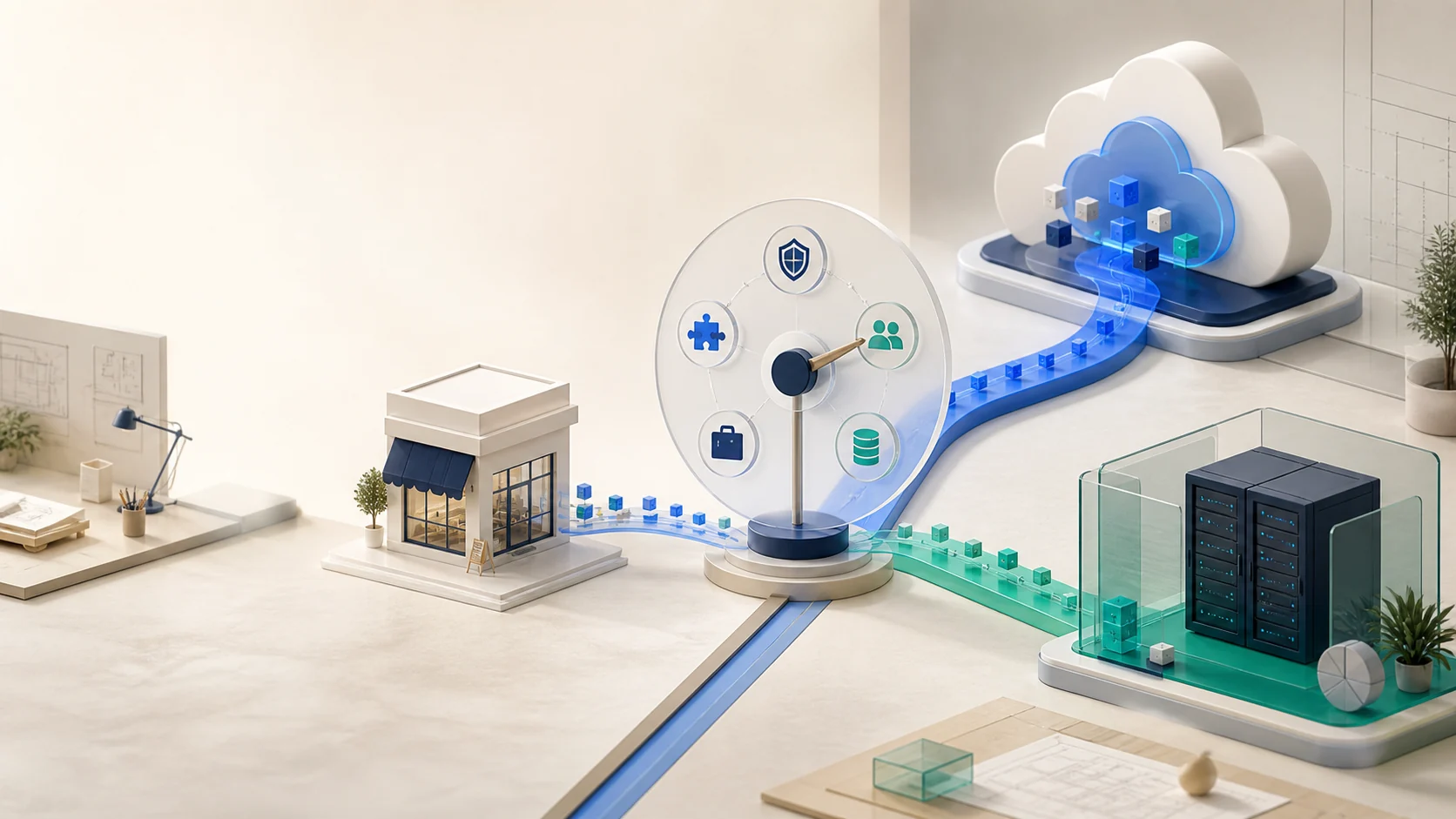
European technology strategy is placing more emphasis on sovereignty, open source and control over data and infrastructure. That context matters for small businesses — but it does not make self-hosting the automatic answer.
A managed service can offer stronger security operations than a server nobody patches. A self-hosted workflow can offer better control than a stack of opaque SaaS tools. A hybrid design can preserve sensitive data boundaries while using managed models for low-risk tasks.
The useful question is not “Which camp are we in?” It is:
Which deployment model gives this workload an acceptable combination of control, reliability, speed, portability and total cost?
Why this decision is becoming more European
In the 2026 Digital Decade Eurobarometer, 82% of respondents said the EU should reduce dependency on third-country digital technologies. Eighty-five percent supported prioritising investment in digital services developed and controlled in Europe, while 58% said they would accept slightly higher costs to switch to an EU-based provider.
Those are public-opinion results, not SME procurement statistics. They do show the political and customer environment in which architecture decisions are being made.
The European Commission's technology-sovereignty agenda addresses cloud, AI, open source and data dependencies. A separate 2026 consultation examines third-country access, international data flows and risks to sensitive data.
For a small company, sovereignty becomes practical when a customer asks:
- Where is our data stored and processed?
- Which suppliers and subprocessors can access it?
- Can you keep this workload in a defined region?
- Can we export the workflow and records if the supplier changes?
- What happens when the service is unavailable or the model is retired?
Three architecture choices
Managed SaaS
The supplier operates the application and infrastructure. The business configures users, integrations and workflows.
Best fit when:
- speed matters more than custom control;
- the data is low or moderate sensitivity;
- the supplier provides appropriate contractual, security and regional options;
- the team has little infrastructure capacity;
- standard integrations cover the process.
Main risks:
- supplier dependency;
- limited observability or export;
- changing prices and product behaviour;
- a long subprocessor chain;
- data moving through more services than expected.
Self-hosted
The company or its infrastructure partner operates the workflow platform, storage and possibly the models.
Best fit when:
- the data or customer contract requires tighter control;
- local connectivity or latency matters;
- the workflow needs deep customisation;
- the organisation can patch, monitor, back up and recover the service;
- avoiding a specific dependency has measurable value.
Main risks:
- false confidence from “our server”;
- unpatched components;
- missing backups and disaster recovery;
- key-person dependency;
- unpredictable compute cost;
- unclear responsibility between host, integrator and business.
Hybrid
Sensitive data, workflow state and controls stay in a managed private environment or self-hosted layer, while selected tasks use an external model or specialist API.
Best fit when:
- workloads have different risk profiles;
- sensitive fields can be minimised or removed before an external call;
- the business needs strong models without operating all infrastructure;
- it wants a migration path rather than one irreversible choice.
Main risks:
- architectural complexity;
- accidental data leakage across the boundary;
- duplicated logging and identity systems;
- nobody owning the end-to-end failure path.
The decision matrix
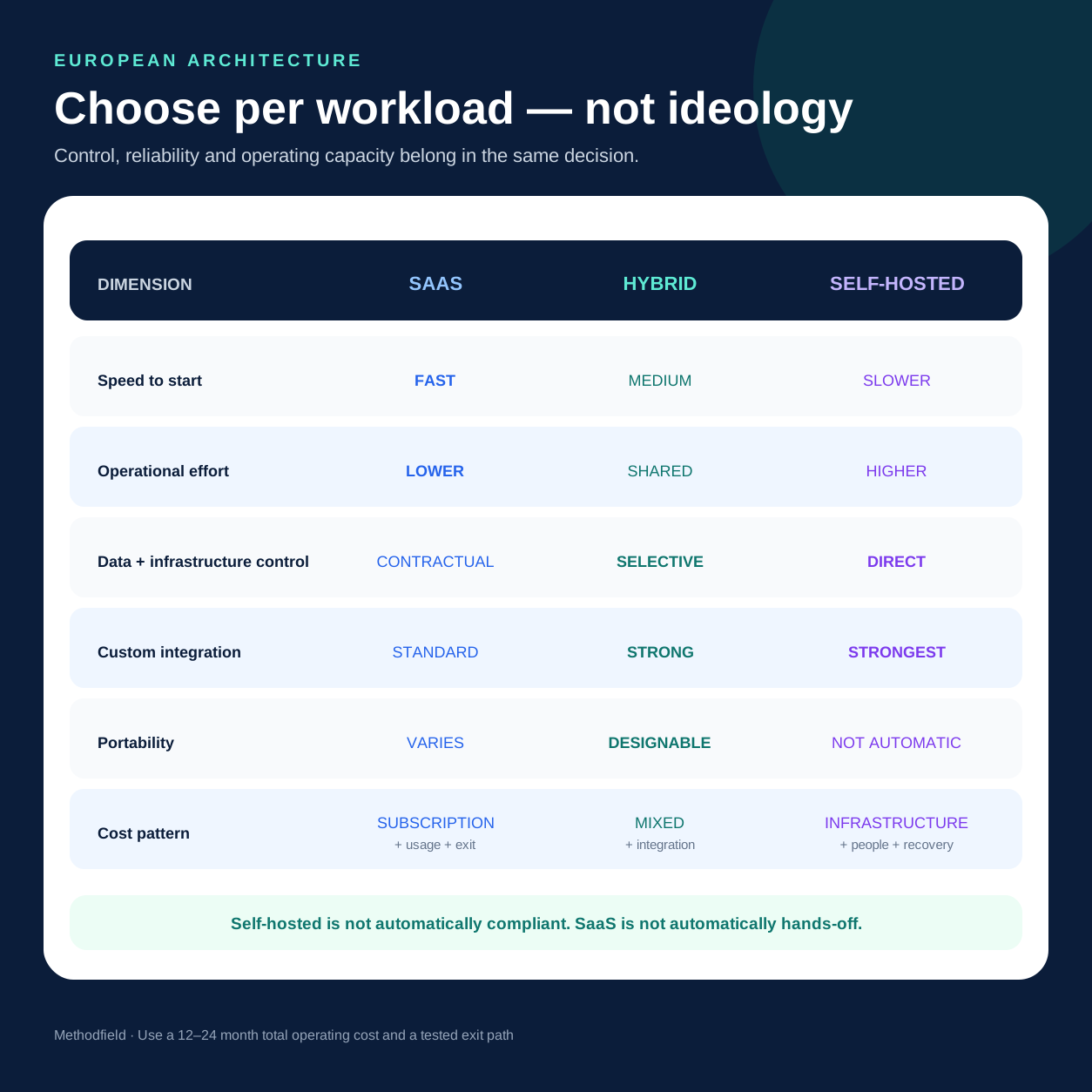
Score each workload, not the company as a whole.
| Dimension | Ask | Pushes toward |
|---|---|---|
| Data sensitivity | Would exposure create material harm or breach a contract? | Hybrid or self-hosted controls |
| Action authority | Can the system change money, contracts, customer access or regulated records? | Greater isolation, evidence and human control |
| Speed to value | Is this a short, low-risk experiment? | Managed SaaS |
| Operational capacity | Can someone patch, monitor and recover the stack? | SaaS if capacity is low |
| Custom integration | Does the workflow require deep system access or unusual logic? | Hybrid or self-hosted orchestration |
| Portability | How costly would supplier exit be? | Open formats, export and modular design |
| Availability | What does one hour or one day of downtime cost? | The option with the strongest realistic recovery, not merely the best brochure |
| Unit economics | How do costs behave with volume? | Depends on usage, people and infrastructure |
If one row is unknown, record the uncertainty. Do not convert it silently into a high score for the preferred option.
A German case: control as a product requirement
In a customer story published by n8n, Germany-based ITNT Media Group says self-hosting was important for data privacy and for keeping sensitive customer data away from US-based SaaS services when required. The company uses the workflow platform across marketing, sales, finance, customer success and project management and reports 96% internal adoption.
The same case says an ecommerce client, Tara-M, increased monthly revenue by 20% after four months of AI-supported SEO, product enrichment and content workflows.
These are vendor-published results, not an independent audit, and the case does not isolate automation as the sole cause of the revenue change. It is still valuable evidence of the buying criterion: deployment control was part of the customer proposition, not an internal technical preference.
Calculate total operating cost, not subscription price
Use a 12–24 month view.
Managed-service cost
- subscriptions and usage;
- premium security or regional hosting;
- integration platform;
- data egress and storage;
- vendor management;
- migration or exit.
Self-hosted cost
- compute and storage;
- installation and integration;
- security hardening;
- monitoring and alert response;
- upgrades and compatibility testing;
- backups and recovery exercises;
- on-call or support partner;
- staff time and key-person risk.
Cost shared by every model
- process design;
- data cleanup;
- evaluation and testing;
- human review;
- incident handling;
- training and change management;
- legal and security review.
A helpful formula is:
Total operating cost = licences or infrastructure + implementation + maintenance + assurance + human review + expected failure cost + exit cost
The cheapest monthly invoice can produce the most expensive dependency.
Minimum controls regardless of deployment
Data map
Document which fields enter the workflow, where they travel, which systems retain them and why. Remove data that the task does not need.
Identity and least privilege
Use separate service identities. Give the workflow read access by default and narrowly scoped write access only when required.
Secrets management
Do not store API keys in prompts, shared spreadsheets or exported workflow screenshots. Rotate credentials and know who can retrieve them.
Logging with restraint
Log enough to investigate actions and errors. Do not create a permanent shadow archive of every customer message. Define retention and redaction.
Version and change control
Record workflow, prompt, model and connector changes. Test high-impact changes on representative cases before release.
Recovery
Backups are not a recovery plan until they are restored in a test. Document how to continue the business process when the AI or orchestration layer is unavailable.
Exit path
Export workflow definitions, structured records, evaluation examples and configuration documentation in usable formats. Test the export before a crisis.
A pragmatic hybrid pattern
Many small European teams can start with this boundary:
- customer and transaction records remain in approved business systems;
- a controlled orchestration layer retrieves only required fields;
- direct identifiers are removed where the task permits;
- an external model handles a bounded language task;
- deterministic validation checks the returned structure;
- sensitive or consequential actions require approval;
- the final record and evidence return to the system of record.
This does not eliminate supplier risk, but it reduces the amount of trust concentrated in one component.
Common decision errors
- “EU-hosted means GDPR compliant.” Location is one factor; purpose, lawful basis, contracts, security and rights still matter.
- “Open source means secure.” Inspectability is valuable, but maintenance and secure configuration remain necessary.
- “Self-hosted means no third parties.” Hosting providers, model downloads, telemetry, support tools and integrations may still create dependencies.
- “SaaS means no operations.” Someone still owns access, configuration, data flows, incidents and supplier changes.
- “One architecture fits every workflow.” A marketing draft and a payment action should not inherit the same risk decision.
Make one workload decision
Select a real workflow and write a one-page architecture decision:
- business outcome and owner;
- data classes;
- systems and regions;
- model and action authority;
- supplier and subprocessor assumptions;
- controls and evidence;
- expected monthly cost at current and doubled volume;
- recovery and exit path;
- review date.
Choose SaaS, hybrid or self-hosted for that workload. The document should be easy to revise when the business, law or supplier changes.
References
- European Commission. “Digital Decade 2026: Special Eurobarometer.” 17 June 2026. Official report (opens in a new tab).
- European Commission. “Strengthening Europe's Tech Sovereignty.” Policy overview (opens in a new tab).
- European Commission. “Targeted consultation on safeguarding the EU's data sovereignty.” 8 July 2026. Official consultation (opens in a new tab).
- n8n. “How ITNT Media Group runs an AI driven business on n8n.” Vendor-published case study (opens in a new tab).
Make the decision explicit in Methodfield
Use FMEA to compare failure modes, Business Model Canvas to connect architecture with the operating model, and Theory of Constraints to avoid optimising infrastructure that is not limiting the workflow.