
AI now participates across the dashboard lifecycle. It can cluster interview notes, propose metric descriptions, write SQL or DAX, generate a wireframe, answer natural-language questions, find anomalies, explain changes and start a workflow.
These uses do not have the same risk. Authoring assistance produces an artifact that can be reviewed before publication. Runtime explanation produces a new answer for each user and query. Runtime action can change the business.
The safest design principle is:
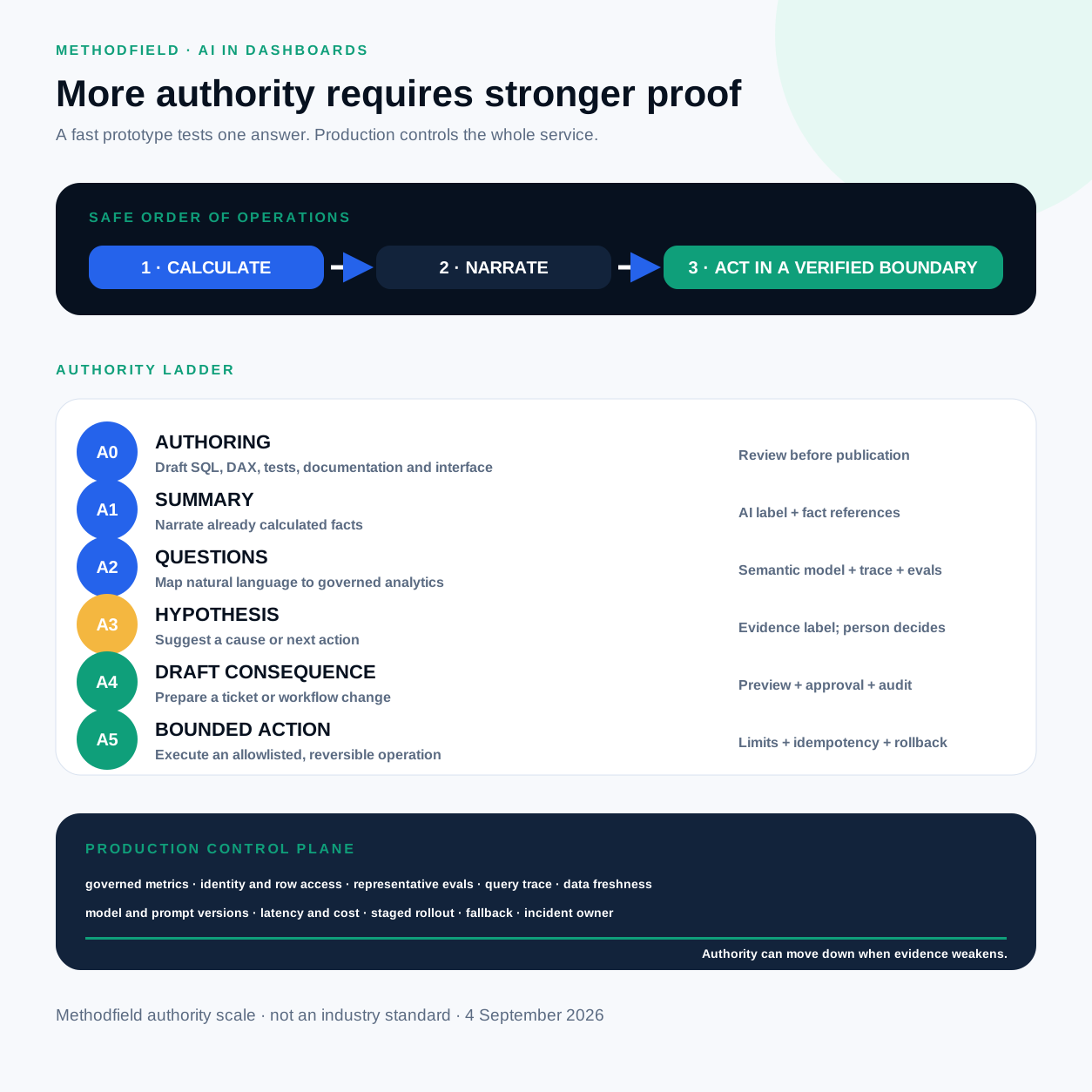
Calculate first. Narrate second. Act only within a verified boundary.
AI changes the interface, not the need for semantics
A classic dashboard answers anticipated questions: state, deviation, trend and segment. A conversational layer lets a user ask an unplanned question:
Why did second-month churn rise among customers in Southern Europe?
The system may select fields, construct a query, build a view and produce an explanation. Before it can do that safely, the organisation must still define churn, customer month, geography, cancellations and row access.
Google describes Conversational Analytics in Looker as natural-language access over a Looker semantic model; LookML remains the source of relationships, definitions and permissions. Microsoft likewise recommends preparing the Power BI semantic model for Copilot and warns that nondeterministic output may not be correct or identical on repeat. These are product statements, not independent accuracy guarantees. Looker Conversational Analytics (opens in a new tab), Power BI Copilot and semantic models (opens in a new tab)
AI lowers the cost of expressing a query, but increases the need for semantic control, observability and answer verification.
Seven useful roles for AI
1. Requirements research
AI can cluster interviews, extract recurring questions, propose a glossary and surface conflicting terms. Treat the result as a workshop input. A generic KPI list cannot reveal real decision rights, incentives or failure cost.
2. Modelling assistant
A model can draft SQL, DAX, calculated fields, tests and documentation. A syntactically valid query can still multiply revenue through a many-to-many join, select the wrong date, compare an open month with a closed one or omit returns. Microsoft explicitly advises developers to understand and validate Copilot-generated DAX across filter contexts.
3. Prototype creator
AI can quickly generate a wireframe, chart specification, dashboard JSON or React component. This is valuable when a team needs a concrete object to debate. Label the artifact as a prototype, keep generated sample data separate from real values, and reconcile generated queries against known cases.
4. Natural-language query interface
The user asks a question; AI maps language to an approved semantic model and returns a number or visualisation. A governed answer exposes:
- the interpreted question;
- selected measures and dimensions;
- filters and time range;
- applied identity and access scope;
- query or inspectable query trace;
- source freshness and quality state;
- a way to correct the interpretation;
- a link to a certified dashboard state.
When revenue or last month is ambiguous, the system should clarify rather
than silently choose the most probable meaning.
5. Narrative and data storytelling
Use a deterministic layer to calculate values and statistical procedures to identify contributions, trends and outliers. Give the language model only those verified facts, then require its narrative to reference them and state limits.
Tableau's documentation describes Tableau Agent in Pulse as answering from precomputed statistical insights. That implementation illustrates the separation; it does not guarantee every generated explanation is correct. Tableau Pulse (opens in a new tab)
6. Anomaly detection and forecasting
Here AI may mean statistical or machine-learning models rather than an LLM:
seasonal baselines, change-point detection, forecast intervals and capacity or
demand predictions. Each anomaly needs an observed value, expected range,
period, model version and reason code. It is a signal to investigate, not an
established cause.
7. Recommendation and action
AI can prioritise exceptions, propose an owner, draft a ticket or start a workflow. Risk rises sharply when it moves from reading to changing.
An authority ladder for dashboard AI
| Level | AI role | Minimum control |
|---|---|---|
| A0 | Helps an author create the dashboard | Code, query and editorial review before publication |
| A1 | Summarises already calculated facts | Visible AI label and references to facts |
| A2 | Answers ad hoc questions | Semantic model, query trace and evaluated question set |
| A3 | Suggests a cause or action | Evidence label; a person decides |
| A4 | Creates a ticket or workflow draft | Preview, approval and audit trail |
| A5 | Performs a bounded action | Allowlist, limits, idempotency, rollback and continuous monitoring |
This Methodfield scale is an original design aid, not an industry standard. Progression depends on evidence and consequences, not on a model's feature list. Authority should also be able to move down when data quality, model performance or review capacity weakens.
Why a prototype looks smarter than production
A demonstration usually has one author, expected questions, a small clean schema, static data, broad access, a known correct answer and no measured cost. The author can retry a poor response without recording it.
Production introduces synonyms, jargon, ambiguous dates and currencies, thousands of fields, metric versions, row-level permissions, incomplete refreshes, multilingual prompts, malformed questions, load, budgets, reproducibility and real consequences.
The proof-of-concept question is therefore not Can it build the right chart once? It is What share of representative questions receives a verifiable answer within the right permissions, latency and cost?
Ground the model in governed objects
Semantic model: expose approved measures, dimensions, join paths and descriptions. Hide unnecessary and dangerous fields. Free text-to-SQL over the entire production database gives language ambiguity the largest possible blast radius.
Verified questions: maintain approved intent–query pairs for recurring
phrases such as net revenue for the last closed month. They act as examples,
regression tests and a deterministic fallback. Looker documents verified
queries for adding context to data agents; availability depends on the product
edition and release state.
Controlled retrieval: when AI explains a metric, retrieve the current metric contract, glossary, release annotations and runbook—not an arbitrary web definition.
Deterministic calculation: let the model select intent and query structure, but calculate money, percentages, statistical tests and thresholds in code or the database.
Output contract: return machine-checkable fields before prose, for example:
{
  "answer_status": "verified | provisional | unable",
  "measure_ids": ["net_revenue_v3"],
  "filters": {"region": "Southern Europe"},
  "period": {"from": "2026-08-01", "to": "2026-08-31", "closed": true},
  "source_freshness": "2026-09-03T08:40:00+01:00",
  "quality_status": "passed_with_warning",
  "result_refs": ["query_run_..."],
  "narrative": "...",
  "limitations": ["Carrier adjustments arrive with a two-day lag"]
}
Production output must not expose hidden identifiers or sensitive payloads.
Build an evaluation set before launch
Collect representative questions from meetings, tickets and interviews. Fifty to two hundred can be a practical starting range, not a standard. Coverage and risk matter more than the number.
For each question, store acceptable paraphrases, expected intent, allowed measures and filters, the correct result over a versioned fixture, required clarification, prohibited fields, latency and error severity.
Measure separately:
| Metric | What it checks |
|---|---|
| Intent accuracy | Business question understood |
| Measure selection | Approved definition chosen |
| Filter and time accuracy | Correct segment and period |
| Numeric correctness | Deterministic result matches |
| Citation or trace coverage | Answer can be inspected |
| Clarification rate | Real ambiguity is surfaced |
| Unsupported-answer rate | System refuses when evidence is absent |
| Permission violations | User scope is enforced |
| Narrative faithfulness | Every claim follows from query results |
| Repeat consistency | Meaning survives repeat and paraphrase |
| Latency and cost | Operation is sustainable |
Use severity-weighted gates. A cosmetic chart error and cross-tenant financial disclosure cannot carry the same weight. NIST's Generative AI Profile organises risk work across Govern, Map, Measure and Manage over the lifecycle; it is a voluntary cross-sector framework, not a ready-made threshold for analytics. NIST AI 600-1 (opens in a new tab)
The related AI Evaluation Operations guide shows how to connect cases, graders, release gates and production feedback.
Measure the real service after launch
Track answers, clarifications and refusals; corrections and regenerations; opening of source/query detail; disagreement with a certified dashboard; failed or slow queries; semantic changes that break tests; cost per useful answer; privacy events; action overrides; incidents and time to contain.
Do not optimise only thumbs-up. A persuasive wrong answer can be popular. Feedback selects cases for review; it is not ground truth.
Make trust visible in the interface
Users must distinguish a semantic-query value, statistical anomaly,
AI-generated narrative, AI hypothesis and recommended action. Put the metric
definition, freshness, warnings, filters, period, source aggregates, lineage,
annotations and limits beside the answer. Let a user correct invoice date
versus order date without silently changing the global metric.
When evidence is insufficient, return unable, explain why and offer a safe
next step. Stylistic fluency cannot compensate for missing facts.
Protect identity, access and data
The conversational layer expands the query surface. Preserve user identity end to end; enforce row, column and tenant rules before query execution; prevent prompt-based discovery of hidden fields; log without unnecessary sensitive payload; protect retrieved metric documentation from injection; control exports and generated links; define prompt/result retention; review data residency; and red-team indirect disclosure and small-group queries.
Google states that Looker Conversational Analytics follows LookML permissions
and also documents compliance and geographic limitations for specific modes.
This is why AI inside BI never replaces a separate privacy and compliance
review.
Operate the AI layer as a versioned product
Version the model/provider, instructions, semantic model, metric definition, query planner, tools, evaluation set, release and rollback target. Run regression tests when any of them changes. Evaluate intent, query plan, numeric result, permissions and unsupported behaviour—not exact prose.
Roll out from internal authors to one business group and then wider. Compare against the deterministic baseline for correctness, response time, analyst workload, cost and new risks.
If AI is unavailable or below threshold, keep certified dashboard states, verified questions, manual filters and analyst escalation. A narrative failure must not hide deterministic facts.
A practical first month
Week 1: choose one audience and decision workflow; approve three to five metric contracts; collect real questions and define forbidden answers.
Week 2: build and reconcile the deterministic dashboard; expose freshness, quality, lineage, action and fallback.
Week 3: enable authoring help or natural-language query for a test group; allow only governed objects; show trace and AI status; run evaluation and red-team cases.
Week 4: compare with baseline; review accuracy, workload, latency, cost and privacy; select A1, A2 or A3 authority; name the owner, cadence and stop rules.
A successful month may end with a reliable deterministic dashboard and AI used only by the author. A fast prototype is not a production service.
Sources
Primary and official references are linked beside the corresponding claims. The core materials are:
- Microsoft — Use Copilot with semantic models (opens in a new tab).
- Google Cloud — Conversational Analytics in Looker (opens in a new tab).
- Tableau — About Tableau Pulse (opens in a new tab).
- NIST AI 600-1 — Generative Artificial Intelligence Profile (opens in a new tab).
These sources confirm architecture, stated functions, limitations and risk practices. They do not independently prove that an AI answer is correct in a specific organisation. The A0–A5 dashboard authority ladder is an original Methodfield design tool, not an industry standard.
Discuss your workflow
Bring one deterministic dashboard state and ten representative questions that people ask about it. Together they are enough to identify the semantic objects, permission boundary, first evaluation cases and the highest AI authority level that current evidence can support.
Start with the trusted-dashboard information model and the source-to-screen architecture.