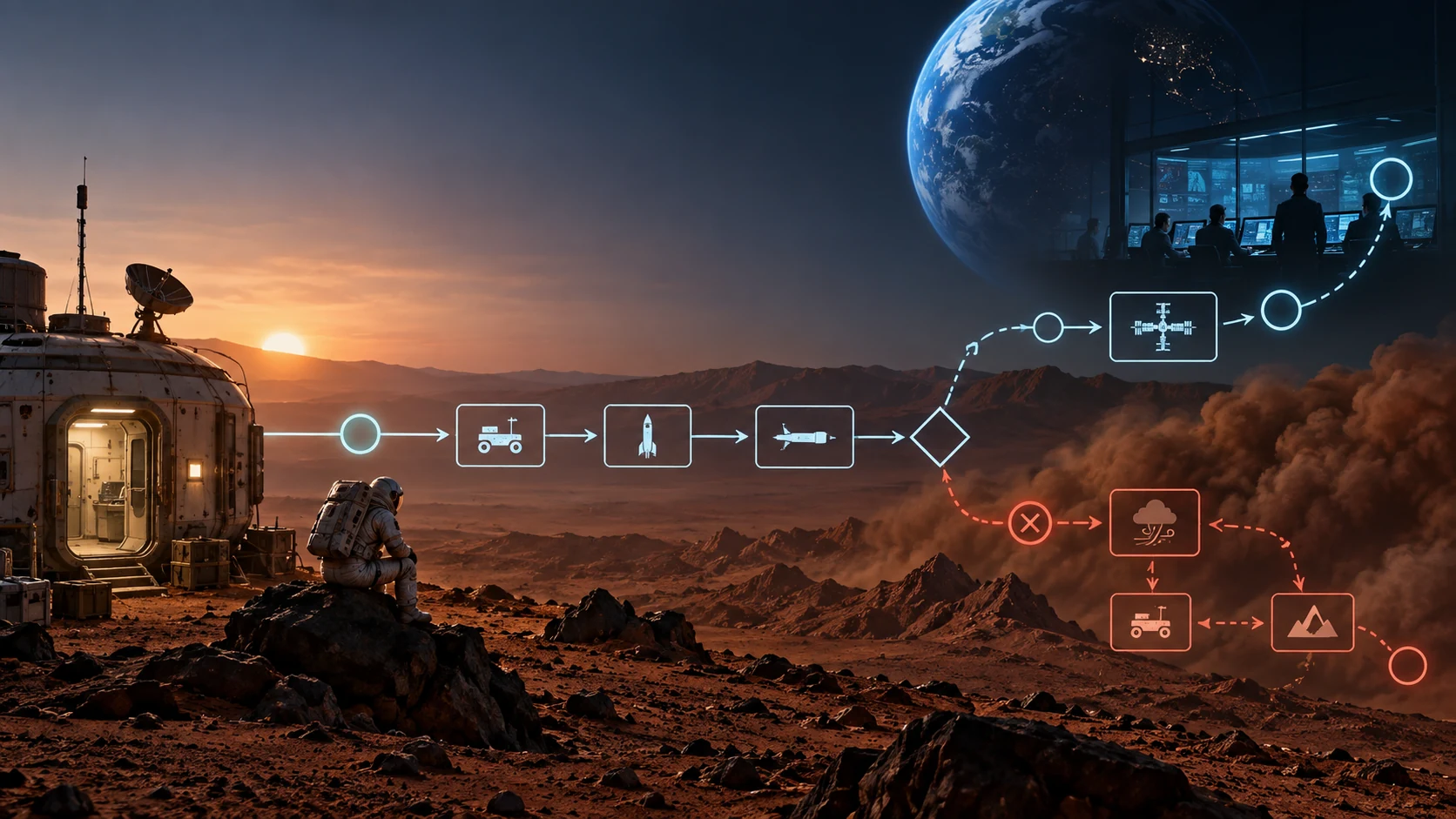
This independent method study examines The Martian through Business Process Model and Notation. It is an interpretation of the publisher's premise, not a claim that the fictional characters used this management method.
Verified premise
An astronaut stranded on Mars must coordinate survival and rescue with limited resources and delayed communication.
Management thesis
The survival workflow in the novel invites a process question: which event starts a response, where does a handoff occur, and what exception route exists when a plan fails?
System map
- Authority: The stranded astronaut and Earth teams control different parts of the rescue process.
- Information: Communication delay means a process cannot assume instant acknowledgment.
- Resources: Power, food, equipment and launch windows are process constraints.
- Incentives: A shortcut can save time yet create a new exception that must be handled.
- Adaptation: A BPMN model would show the trigger, handoffs and fallback route for each critical step.
Apply the method
- Name the start event and desired end state.
- Trace actual tasks and responsible participants.
- Add gateways only where a rule changes the path.
Failure mode
Mistaking a neat diagram for observed practice, or modelling every detail before the boundary is agreed.
Ethical cost
A useful analogy must still identify whose voice, rights or exposure to harm the method could hide.
Limits of the analogy
Space survival exaggerates exception severity; BPMN describes flow rather than proving a safe engineering design.
Discussion question
Which assumption in this fictional system would you test before using the method in your own organisation?