
Europe does not have an AI-access problem. A small company can open a chatbot, connect a no-code automation platform and produce an impressive demonstration in a day.
The harder problem begins the following Monday: the demonstration has no reliable input, no owner, no exception route, no baseline and no safe way to change a customer or financial record.
The latest evidence describes that gap. Eurostat reports that 20% of EU enterprises used AI in 2025, up from 13% in 2024. Adoption reached 55% among large enterprises but 19% among SMEs. The OECD's 2026 D4SME survey says use of off-the-shelf AI is growing while strategic, targeted and secure integration remains uneven.
The obstacle is rarely one missing prompt. It is the operating system around the model.
Read the adoption number carefully
Eurostat's business survey covers enterprises with at least ten employees or self-employed persons. In this dataset, SMEs have 10 to 249 people. The 19% figure therefore does not describe Europe's smallest microbusinesses.
The country range is also wide. In 2025, reported enterprise AI use was 42% in Denmark, 38% in Finland and 35% in Sweden and Belgium, compared with 5% in Romania, 8% in Poland and 9% in Bulgaria, Greece and Cyprus.
The useful lesson is not that one country has found a universal playbook. It is that “European SME” covers very different levels of digital infrastructure, skills, financing and supplier access. An adoption plan should start from the actual workflow and capacity of the company, not from a continental average.
Why a useful demo still fails in production
The task is personal, but the process is shared
A founder can use AI to draft a proposal. Production automation must also know:
- which pricing table is current;
- who can approve a discount;
- whether the customer has opted into the channel;
- what happens when required data is missing;
- where the final document is stored;
- how the CRM is updated without creating duplicates.
The demo solves a task. The business needs a process.
The input has no contract
Models are forgiving during a demonstration. Business systems are not. A production workflow needs an input contract: required fields, accepted formats, language, source, freshness and validation.
If a quote requires country, currency, tax treatment, delivery date and margin floor, those fields should be explicit. Do not expect a model to infer every missing value correctly from an email.
The output has no owner
“The AI produced it” is not ownership. One person must be accountable for the business outcome and another may own the technical workflow. Name both.
Without an outcome owner, nobody decides whether an error is acceptable, which exceptions require escalation or when the system should be paused.
The pilot measures delight, not value
Teams often collect reactions such as “the summary looks good.” That is useful during discovery but insufficient for investment.
Production metrics should connect the workflow to time, quality, speed, revenue capacity or risk:
- minutes of active work per case;
- elapsed time from request to usable output;
- first-pass acceptance rate;
- correction rate by error type;
- number of cases completed per week;
- conversion or retention where a causal link can be tested;
- incident and escalation rate.
The organisation cannot maintain it
The OECD identifies time constraints, maintenance costs and skill gaps among barriers to effective SME digitalisation. Every integration creates a small maintenance obligation: credentials expire, APIs change, fields are renamed and model behaviour shifts.
A production plan needs a maintenance budget, even if the software subscription is inexpensive.
The pilot-to-production ladder
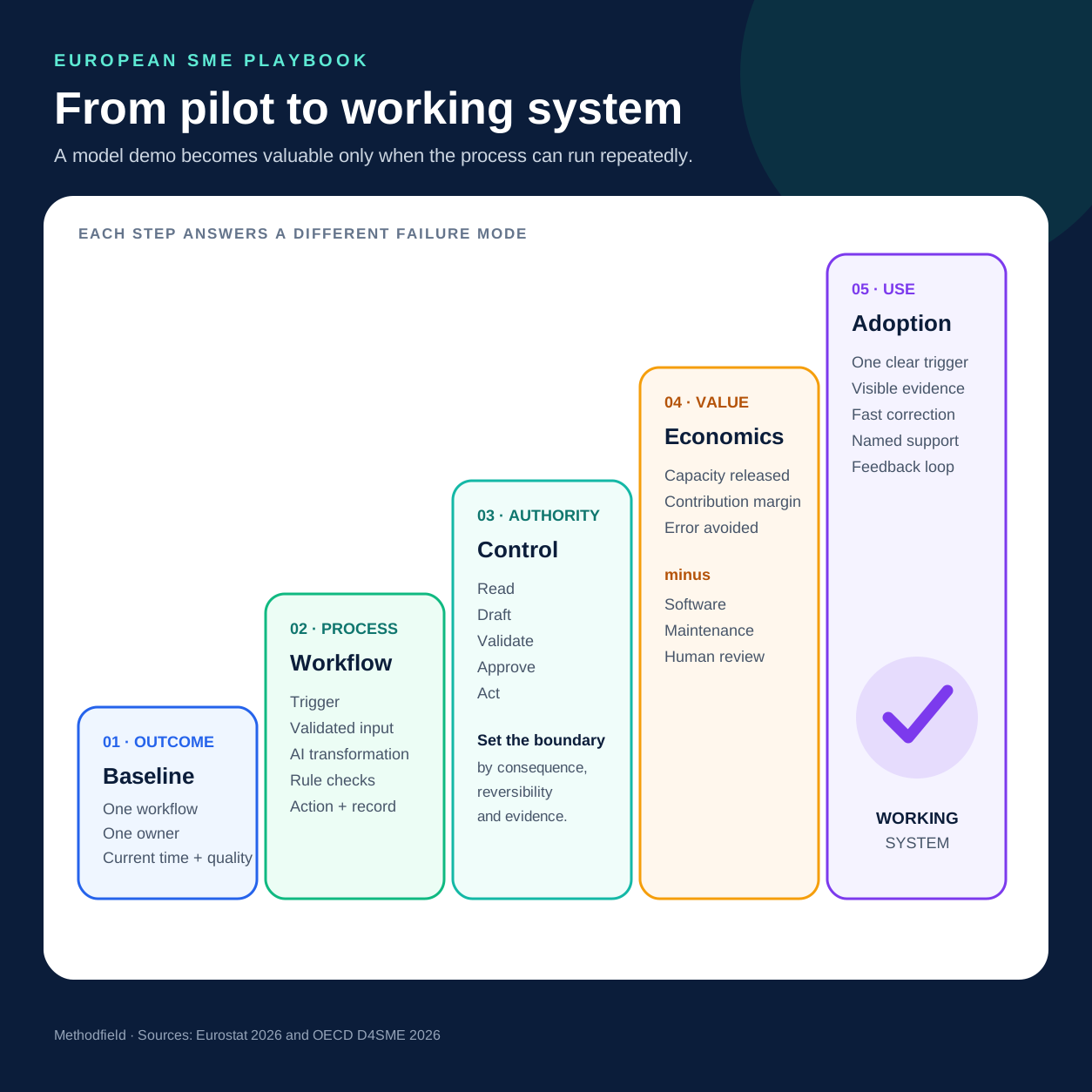
Step 1: Define one outcome and a baseline
Choose one frequent, bounded workflow. Good candidates have:
- repeated inputs;
- a visible bottleneck;
- an output that can be reviewed;
- enough volume to learn;
- a tolerable cost of early mistakes.
Record the current baseline before automation. For example: 46 minutes of active work, 30 hours of elapsed time, 18% rework and 40 cases per month.
Do not choose “use AI in sales.” Choose “prepare a first proposal draft from a validated brief.”
Step 2: Draw the workflow around the model
Map the sequence from trigger to final record:
- request arrives;
- required data is validated;
- approved sources are retrieved;
- AI transforms or classifies the information;
- rules check limits and required fields;
- a person reviews exceptions or consequential outputs;
- a deterministic service performs the action;
- the result and evidence are logged.
This map reveals which parts need AI and which parts need ordinary software.
Step 3: Design the control boundary
For every step, ask what the system may do without approval.
| Action | Sensible starting boundary |
|---|---|
| Summarise an internal call | Automatic, with source link |
| Draft a customer email | Automatic draft; human sends |
| Update a low-risk CRM note | Automatic after schema validation |
| Change price or contractual terms | Human approval |
| Issue a refund or payment | Rule-based limits plus approval |
| Delete customer data | Authenticated, logged human action |
The right boundary depends on consequence, reversibility and evidence — not on how confident the prose sounds.
Step 4: Test the economics
Use a simple monthly model:
Net workflow value = labour capacity released + incremental contribution margin + avoided error cost − software − maintenance − review cost
Avoid counting every saved minute as cash. Time creates value only if the company can redeploy it, increase throughput, improve service or avoid hiring.
Include review and maintenance. A workflow that saves 20 minutes but adds 15 minutes of checking has a very different business case from the demo.
Step 5: Build adoption into the process
The employee should not need to remember five prompt templates or copy data between six windows. Put the new workflow where work already begins: the CRM, inbox, service desk, order system or shared form.
Provide:
- one clear trigger;
- visible source material;
- a short review interface;
- an easy correction route;
- a named support owner;
- a feedback category for recurring defects.
Adoption is not a training event. It is a property of the workflow design.
A 30-day SME pilot
Week 1: Baseline and design
- select one workflow and owner;
- collect 20–50 representative examples;
- define success and stop metrics;
- classify personal and sensitive data;
- document the current process and cost.
Week 2: Build the smallest controlled version
- use read-only access where possible;
- separate AI transformation from deterministic action;
- implement required-field and limit checks;
- keep a human approval point;
- log inputs, outputs, decisions and failures proportionately.
Week 3: Run in shadow mode
The system produces an output, but the existing process remains authoritative. Compare:
- completion time;
- acceptance without edits;
- serious and minor errors;
- missing evidence;
- employee effort and confusion.
Week 4: Limited live release
Release to a narrow user group or low-risk case class. Review defects daily. Decide whether to expand, redesign or stop.
Stopping is a valid result. A well-run pilot can show that data cleanup or conventional automation should come first.
Use European support infrastructure
The European Digital Innovation Hub network is being refocused as a first line of AI support. The European Commission says EDIHs can help SMEs test and deploy AI, access specialist expertise and navigate AI Act questions. Services differ by region, so locate the relevant hub and ask specifically about “test before invest,” data assessment, cybersecurity and regulatory sandboxes.
Public support will not supply an internal process owner. It can reduce the cost of finding expertise and testing options.
The operating question to ask
Do not finish the pilot review with “Did the model work?”
Ask:
Can this workflow produce a useful result repeatedly, within a known cost and time, with visible evidence, controlled authority and an owner who can improve it?
That is the difference between access to AI and an AI-enabled business system.
References
- Eurostat. “Digitalisation in Europe — 2026 edition.” Official statistics (opens in a new tab).
- OECD. “Empowering SMEs in the age of AI: The 2026 OECD D4SME Survey.” 13 April 2026. Policy paper (opens in a new tab).
- European Commission. “Commission announces renewed funding for 83 European Digital Innovation Hubs.” 8 October 2025. Programme announcement (opens in a new tab).
Continue in Methodfield
Map the current process with Value Stream Mapping, find the limiting step with Theory of Constraints, examine failure modes with FMEA, and run the smallest safe production test with PDCA/PDSA.