Need a complete decision session around this simulation? Open the Decision Workshop playbook.
Decision Room is a simulation in which participants must simultaneously earn scarce executive attention, shorten material without hiding alternatives or uncertainty, define a specific management action and adapt when new evidence appears.
The game assesses communication quality—not the ability to sell a preferred option.
A team receives no points merely because the committee selects its recommendation.
Use the guided Decision Room case for individual preparation. This guide supports a live group session.
Audience and learning outcomes
The simulation is designed for transformation offices, Operational Excellence, business systems, Strategy, PMO, Digital / AI / HR Transformation, internal consultants and leaders who prepare committee materials.
Recommended size: 8–18 people. A first session works best with 9–12.
Participants practise how to:
- start with business tension rather than a method;
- build a 30-second executive entry;
- reveal information in layers;
- separate fact, hypothesis, forecast, assumption and recommendation;
- compare options using common criteria;
- recognise material information;
- translate sponsorship into observable behaviour;
- change a recommendation without losing trust;
- accept informed disagreement as a valid outcome.
Case summary
NordForge Industrial Group is a fictional industrial-equipment manufacturer with three sites. Over six months, OTIF fell from 94% to 87%, delays affected major customers and urgent cross-functional escalations increased by 42%.
The team considers four options:
| Option | Scope | Cost | Horizon | Expected OTIF effect | Main risk |
|---|---|---|---|---|---|
| A — Local Quick Fix | local boards and daily meetings | €0.4m | 3 months | +1–2 points | local optimisation |
| B — Flow Pilot | end-to-end flow at two sites | €1.2m | 6 months | +3–5 points | limited evidence |
| C — Enterprise System | common system at all sites | €4.8m | 12 months | +5–8 points | technology and change load |
| D — Wait and Learn | diagnosis and return to decision | €0.15m | 3 months | no direct effect | losses continue |
The synthetic data support decision-architecture practice but deliberately do not produce one mathematically correct answer.
Roles
One group, 8–12 people
- Transformation Team — 3–5;
- Executive Committee: CEO, CFO and COO — 3;
- Decision Integrity Observers — 1–3;
- facilitator — 1.
There is no winner in this format. The result is a capability profile.
Multiple teams, 13–18 people
Create two Transformation Teams of 3–4 and one committee of three. Teams prepare in parallel and present sequentially. Give both teams the same evidence and stress card. The committee records a decision after each presentation but reveals neither until both are complete.
Information distribution
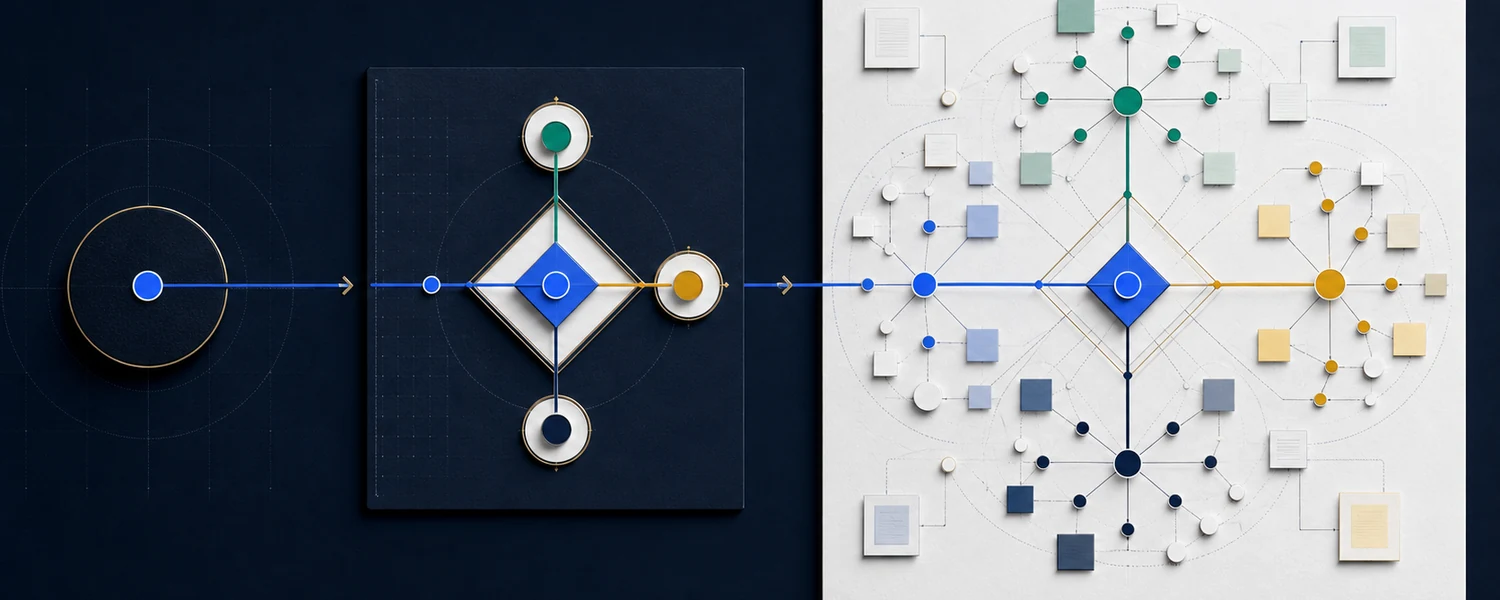
The diagram shows the information asymmetry. Everyone sees the case and options. The Transformation Team also receives five material evidence cards. The Executive Committee receives role-specific priorities. Observers receive the materiality map and record when each fact becomes visible.
Evidence cards for the Transformation Team
- Demand. Forecast growth is 8%; scenario range is –3% to +14%.
- Pilot Evidence. A prior area improved 17%, while its leader, product mix and planning resource also changed.
- Technology. The vendor forecasts six months; two available benchmark cases took 10–14 months.
- Customer Risk. A major customer warned that further deterioration could affect next year's orders; no confirmed loss exists.
- Change Capacity. ERP migration, cost reduction and commercial reorganisation are already running.
Hidden roles
- Transformation Lead: your manager informally expects Option C to be approved. Integrity matters more than compliance with that preference.
- CEO: eleven agenda items remain. Continue only if the issue becomes relevant in 30 seconds.
- CFO: you believe complex transformations are routinely undercosted and initially lean toward A or D.
- COO: you are tired of local fixes and initially lean toward C, but worry about change capacity.
- Observer: do not select the best option; record asymmetry, hidden assumptions, claim confusion and material omissions.
Materiality map
Information is material if it could reasonably change the option, scale, timing, condition or confidence of the decision.
| Card | Why it matters | When it should appear |
|---|---|---|
| Demand | affects value, urgency and waiting | before the choice; within 3 minutes if growth supports the case |
| Pilot Evidence | weakens causal claims for B | within 3 minutes if B is presented as proven |
| Technology | changes timing and risk for C | within 3 minutes if C is seriously considered |
| Customer Risk | affects “why now” but does not prove lost revenue | before the decision, without exaggeration |
| Change Capacity | changes the feasibility of C | within 3 minutes if C is considered |
Not every fact belongs in the first 30 seconds. Every decision-changing fact must be accessible before the choice.
90-minute agenda
| Time | Stage | Facilitator action |
|---|---|---|
| 0–10 | Introduction | purpose, core rule, clarity versus steering |
| 10–20 | Case and roles | distribute materials privately |
| 20–27 | Prepare 30 seconds | start timer; do not coach content |
| 27–32 | Round 1 | pitch and Continue / Clarify / Stop |
| 32–35 | Fast feedback | one observation from CEO and observer |
| 35–47 | Prepare 3 minutes | team completes decision frame |
| 47–50 | Round 2 | stop at exactly 3 minutes |
| 50–58 | Executive Challenge | CEO, CFO and COO questions |
| 58–66 | Stress Card | 3 minutes to prepare, up to 5 to respond |
| 66–71 | Committee decision | option, confidence, rationale, missing information |
| 71–78 | Integrity Reveal | open cards and identify omissions |
| 78–90 | Debrief | decision, communication, workplace transfer |
Express version — 30 minutes
Use 5 minutes for the case and roles, 4 for hook preparation, 2 for the pitch, 5 for the decision frame, 3 for the presentation, 3 for one challenge, 2 for the decision, 3 for the reveal and 3 for debrief. Do not add a separate stress card.
Extended version — 120 minutes
Add a weak/strong entry demonstration, a second 30-second attempt, a ten-minute challenge, a ten-minute stress response, extended debrief and a personal transfer plan.
Round 1 — Earn Attention
In 30 seconds, the team explains what is happening, why it matters, why now and what next step is required.
The team may not start with Lean, AI, a programme name or a tool; use more than three numbers; present a forecast as fact; or request final funding before showing options.
The CEO selects:
- Continue — grant three minutes;
- Clarify — ask one question and grant 15 seconds;
- Stop — state what was missing and allow a second attempt.
Round 2 — Decision Architecture
The team presents the decision, why now, two to four facts, mechanism hypothesis, A/B/C/D under common criteria, recommendation, main risk, uncertainty and specific ask.
Do not penalise a changed recommendation. Evidence-based change improves Adaptability.
Round 3 — Executive Challenge
Ask one question each:
- CEO: “What would have to be true for your recommendation to be wrong?”
- CFO: “Which fact makes the cheaper option reasonable?”
- COO: “What must the organisation stop doing to create capacity?”
Then ask: “What did you deliberately leave out of the first three minutes, and why?”
Round 4 — Stress Card
Choose one:
- Time Collapse: “You have 60 seconds left. What must I understand before deciding?”
- New Evidence: the largest customer accepts a three-month inventory buffer funded by NordForge.
- Sponsor Pressure: the COO asks the team to show only C.
- Uncomfortable Assumption: the maximum C effect assumes 95% utilisation; current utilisation is 74%.
- No Decision Today: the CEO refuses funding and asks for the minimum sensible action now.
After the response, ask what changed in the facts, interpretation, recommendation and material information.
Committee decision
The committee records:
- selected option or additional test;
- confidence from 1 to 5;
- rationale in no more than three sentences;
- information that could change the decision;
- owner and next checkpoint.
A choice with no owner or checkpoint is a discussion, not a completed management action.
Decision Communication Quality Score — 100
| Dimension | Points |
|---|---|
| Executive Attention | 20 |
| Business Relevance | 15 |
| Decision Architecture | 20 |
| Decision Integrity | 25 |
| Leadership Ask | 10 |
| Adaptability | 10 |
Use the same anchors for each criterion: 0 — absent or misleading; 1 — mentioned but not useful; 3 — clear and usable; 5 — specific, testable and improves the decision. Scores of 2 and 4 are allowed.
Do not add separate arithmetic penalties for issues already scored under Integrity. If a team knowingly conceals a material fact after a direct question, Decision Integrity is capped at 10/25. Hear the team's explanation before inferring intent.
Executive Committee diagnostic — 30
Score 0–10 for each:
- questions test logic rather than demonstrate status;
- the decision is grounded in facts and criteria;
- uncertainty becomes conditions, ownership and a checkpoint.
This diagnostic does not select a winner. It assesses the decision-making side.
Example of a strong result
We recommend B, a cross-functional pilot at two sites. It tests the mechanism with limited capital and lower change load than C. We cannot attribute the previous pilot's full 17% improvement to the new system, so we request a transferability test with predefined criteria, not enterprise scale-up.
The ask:
The COO appoints the flow owner, the CFO confirms a €1.2 million limit and the committee returns to scale-up in six months if agreed thresholds are met.
D can also be strong when the committee defines a three-month diagnostic plan, cost of delay and decision triggers.
Integrity Reveal and debrief
Open evidence cards one by one. Ask whether the information was disclosed, how it could affect the choice, at which level it belonged and whether omission was legitimate compression or concealment.
Then ask:
- What did the committee decide and why?
- What actually earned attention?
- Which fact was hardest to disclose?
- Where did progressive disclosure almost become concealment?
- What did the team present as more certain than it was?
- Which committee question improved the decision?
- What will participants change in their next real executive material?
Close with:
Attention → Relevance → Understanding → Choice → Action
while preserving:
Evidence + Alternatives + Trade-offs + Uncertainty