
A useful automation case starts with a bottleneck, not a chatbot.
BeGlobal, a Dutch supplier of branded corporate gifts, works with a catalogue of roughly 100,000 items. A proposal for a large client has to combine occasion, budget, availability, material, colour, brand context, product imagery and presentation design. According to a case study published by workflow-platform vendor n8n, that work previously took several hours and limited the company to about 50 proposals per year.
The new workflow reportedly creates a presentation in about 52 seconds. The case study estimates potential capacity at almost 500 proposals per year.
Those numbers are impressive, but the most reusable insight is the architecture: AI does not write a generic proposal. It coordinates a structured search and a reusable production system.
Evidence note
The implementation was delivered with PromptGorillas and published as an n8n customer story. The figures are vendor-reported and have not been independently audited. The case provides no long-term conversion, margin or revenue result.
Treat “almost ten times more proposal capacity” as a throughput claim, not proof of ten times more sales.
The original constraint
The sales team did not lack products. It had too many possible products and a labour-intensive path from client need to usable offer.
The manual process included:
- understanding the occasion, client, quantity and budget;
- searching a large product database;
- checking practical constraints;
- selecting a coherent shortlist;
- finding or creating appropriate images;
- writing product descriptions;
- assembling and formatting slides;
- checking the result before sending.
Hiring another salesperson would not remove the process constraint. It would add another person performing the same search and assembly work.
The automated workflow
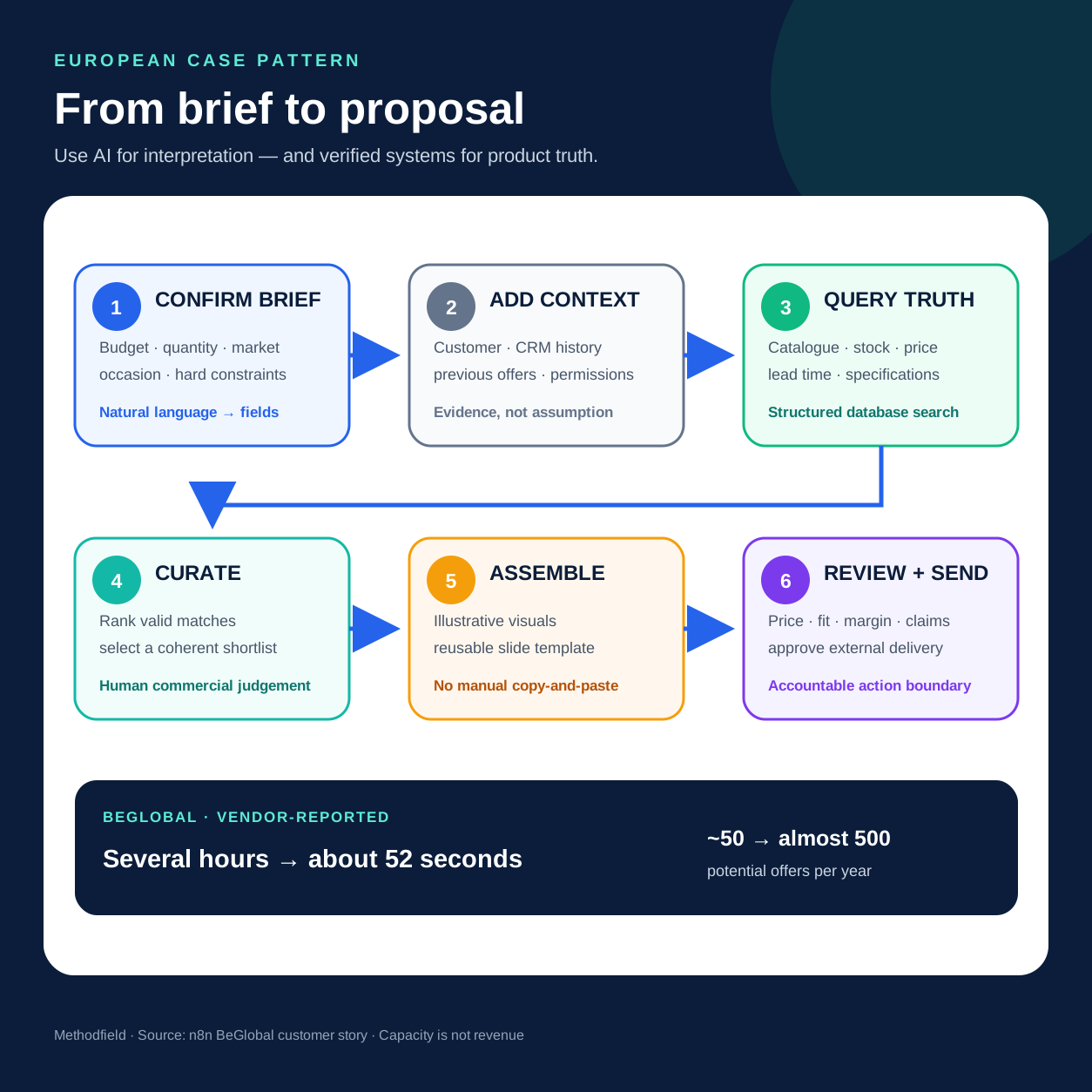
1. Conversational intake
A custom interface collects the product type, budget per unit, occasion, client identity and whether the customer is new or existing. The assistant summarises the brief and asks the user to confirm it.
The confirmation step matters. Natural-language intake is useful precisely because customer requests are messy. It should become structured data before the database query begins.
2. Client and history lookup
For an existing customer, the workflow can retrieve CRM information and prior proposals. That creates continuity without asking the salesperson to rebuild context from memory.
Historical context should be used carefully. A previous choice is evidence, not a permanent preference. Show the retrieved fact to the reviewer and preserve its source.
3. Structured catalogue search
The system queries product data stored in Supabase. The case describes GPT-assisted query generation alongside code nodes that construct precise SQL from the confirmed constraints.
This combination is important:
- language models interpret an imprecise request;
- structured queries retrieve actual records;
- code enforces syntax and data shape;
- the database remains the source of product truth.
The model should not invent a product, price or availability when the catalogue returns no match.
4. Curated selection
The result is returned to the interface for selection. A person remains able to judge taste, commercial fit and client nuance.
That division is sensible. Automation can shrink 100,000 records into a valid shortlist. A salesperson can make the final recommendation and notice that two technically valid products feel wrong together.
5. Themed visual generation
Selected product images pass through an image-generation step to create occasion-specific presentation visuals. This removes repetitive visual assembly but creates a new control need: the generated image must not misrepresent the physical product, colour, packaging or included accessories.
For a publishable proposal, distinguish mood imagery from evidence of what will be delivered.
6. Template-based presentation
A Google Slides template defines the layout. The workflow duplicates the required slide structure and fills it with product details, price and imagery.
Templates do more than save design time. They constrain the output. Every slide can reserve a predictable position for price, minimum order, delivery notes and disclaimers.
Why the workflow can be fast
The reported 52-second result is not “AI thinking like an expert salesperson at superhuman speed.” It is the removal of queueing and hand-offs:
- the brief is captured once;
- constraints become structured fields;
- search runs across the whole catalogue;
- results move directly into a template;
- the presentation is generated without manual copying.
The creative and commercial judgement is concentrated at review rather than repeated during file assembly.
A reusable blueprint for a small B2B company
This pattern fits distributors, wholesalers, agencies, event suppliers, travel designers, equipment dealers and professional-service firms that repeatedly assemble offers from structured components.
Define the proposal object
Before choosing tools, list the minimum fields:
- customer and market;
- requested outcome;
- budget and currency;
- quantity or scope;
- hard exclusions;
- delivery or completion date;
- price source and validity date;
- selected items or service modules;
- assumptions;
- reviewer and approval state.
If the proposal cannot be represented consistently, automation will produce faster inconsistency.
Separate hard constraints from preferences
Hard constraints belong in deterministic filters:
- stock availability;
- minimum order quantity;
- country restriction;
- margin floor;
- certification;
- delivery deadline;
- contractual exclusion.
Preferences can use ranking or AI interpretation:
- tone;
- style;
- thematic fit;
- similarity to previous choices;
- diversity of the shortlist.
Never let a soft ranking override a hard commercial limit.
Use the database as truth
Every price, SKU, lead time and specification should come from an approved system with a timestamp. The model may explain or arrange those facts, but it should not become the source of them.
Where product data is incomplete, send the item to a data-quality queue instead of silently filling the gap.
Keep the template modular
Build reusable sections:
- cover and client context;
- executive recommendation;
- one item or module per slide;
- alternatives;
- pricing and assumptions;
- next step.
Modularity makes the output easier to test. It also supports country, language and brand variants without redesigning the workflow.
Place human review where judgement is valuable
A good review screen shows:
- the confirmed brief;
- why each item matched;
- source records and freshness;
- margin or policy warnings;
- generated imagery marked as illustrative;
- the final document before external delivery.
Do not force the reviewer to reopen four systems to verify the proposal. Bring the evidence to the decision.
Build the business case without exaggeration
Measure four separate outcomes.
1. Active time
How many minutes of employee work are required before and after automation? Include review and correction.
2. Elapsed time
How long does the customer wait from request to usable proposal? A 52-second generation step may still sit behind a two-day approval queue.
3. Capacity
How many qualified proposals can the team produce? Track whether the extra capacity is actually used.
4. Commercial result
Measure acceptance, contribution margin, sales-cycle length and revenue separately. More proposals can create more revenue, but only when demand, follow-up and delivery capacity exist.
A simple value model is:
Annual value = usable capacity released + incremental contribution margin − software − implementation − maintenance − review cost
Risks to test before launch
- obsolete or missing catalogue data;
- a generated query that broadens or drops a constraint;
- duplicate client records;
- price or currency mismatches;
- synthetic imagery that implies an unavailable feature;
- slide overflow in translated versions;
- accidental use of one client's history in another proposal;
- automatic sending before commercial approval;
- no fallback when a supplier API fails.
Run a shadow pilot across ordinary, edge and deliberately incomplete requests. A beautiful average-case deck is not enough.
The transferable lesson
The strongest proposal automation does not ask AI to “create something persuasive” from an empty page. It creates a controlled route through verified data, reusable structure and human judgement.
Start with the bottleneck: search, selection, assembly or approval. Then give AI only the parts where language and ambiguity create genuine work.
Reference
- n8n. “How BeGlobal cut time-to-market for their commercial offer creation with n8n.” Vendor-published case study (opens in a new tab).
Rebuild the pattern in Methodfield
Use Value Stream Mapping to separate active work from queue time, Theory of Constraints to locate the real proposal bottleneck, and Mistake Proofing to prevent invalid prices, missing fields and premature sending at the action boundary.