
The loudest AI idea is rarely the best first project.
A general chatbot may look more impressive than fixing an incomplete enquiry workflow. An autonomous agent may attract more attention than validating the fields in a recurring document. A forecasting project may sound strategic even when the business has no stable definition of demand or no owner for the resulting decision.
The practical starting question is not:
Where can we add AI?
It is:
Which repeated workflow contains a valuable, measurable problem that AI can improve without creating disproportionate risk or operational burden?
This guide introduces a Methodfield working tool for comparing opportunities before a team chooses a model, vendor or architecture.
The short answer
A strong first AI workflow usually has:
- a visible operational problem;
- enough repeated volume to matter;
- a clear owner;
- representative examples;
- an output that can be checked;
- a safe path for exceptions;
- a measurable baseline;
- users who will change how they work if the system succeeds.
An opportunity is weak when the technology is clear but the workflow, outcome or owner is not.
Start with a workflow, not a department
“AI for sales” and “AI for operations” are too broad to design or evaluate.
A workflow has a beginning, an end and an observable result. For example:
- an enquiry arrives and reaches the correct next action;
- a document arrives and its required fields are validated;
- a customer conversation ends and a reviewed follow-up is scheduled;
- an employee asks a question and receives an answer linked to an approved source;
- a recurring management report is produced and every claim can be traced to underlying data.
This boundary makes the current process visible. It also makes it possible to compare AI with ordinary automation, a process change or doing nothing.
The NIST AI Risk Management Framework describes this contextual work through its Map function: intended purpose, users, impacts, assumptions and limitations should be understood before risks and controls are measured. For a small business, the same principle can be applied without creating a large governance programme: define the workflow and consequence before selecting the system.
Three gates before scoring an opportunity
Do not rank a candidate yet if any of these gates is missing.
Gate 1: a named business owner
Someone must be accountable for the outcome, not only for the software.
The owner can answer:
- what good performance means;
- which exceptions require judgment;
- which actions the system must never take alone;
- what should happen when the system is unavailable;
- whether the improved output changes a real decision or customer outcome.
Gate 2: an observable baseline
The baseline does not need to be perfect, but it must be usable.
Possible measures include:
- first-response time;
- completion time;
- missing-field rate;
- correction or rework rate;
- cases escalated;
- cost per completed workflow;
- conversion to the next agreed step;
- quality against a defined rubric.
Without a baseline, a team may be able to demonstrate that the AI works but not that the workflow improved.
Gate 3: a feasible operating boundary
The team must know which data can be used, which systems can be connected and which actions require approval. A candidate that depends on inaccessible data, an unsupported integration or unacceptable authority is not ready for a prototype. It may still be worth preparing, but it should not compete with ready opportunities as if the uncertainty were the same.
The AI Workflow Priority Sheet
Score each dimension from 1 to 5 to compare candidates. The score is a conversation aid, not a scientific index or an automatic approval rule.
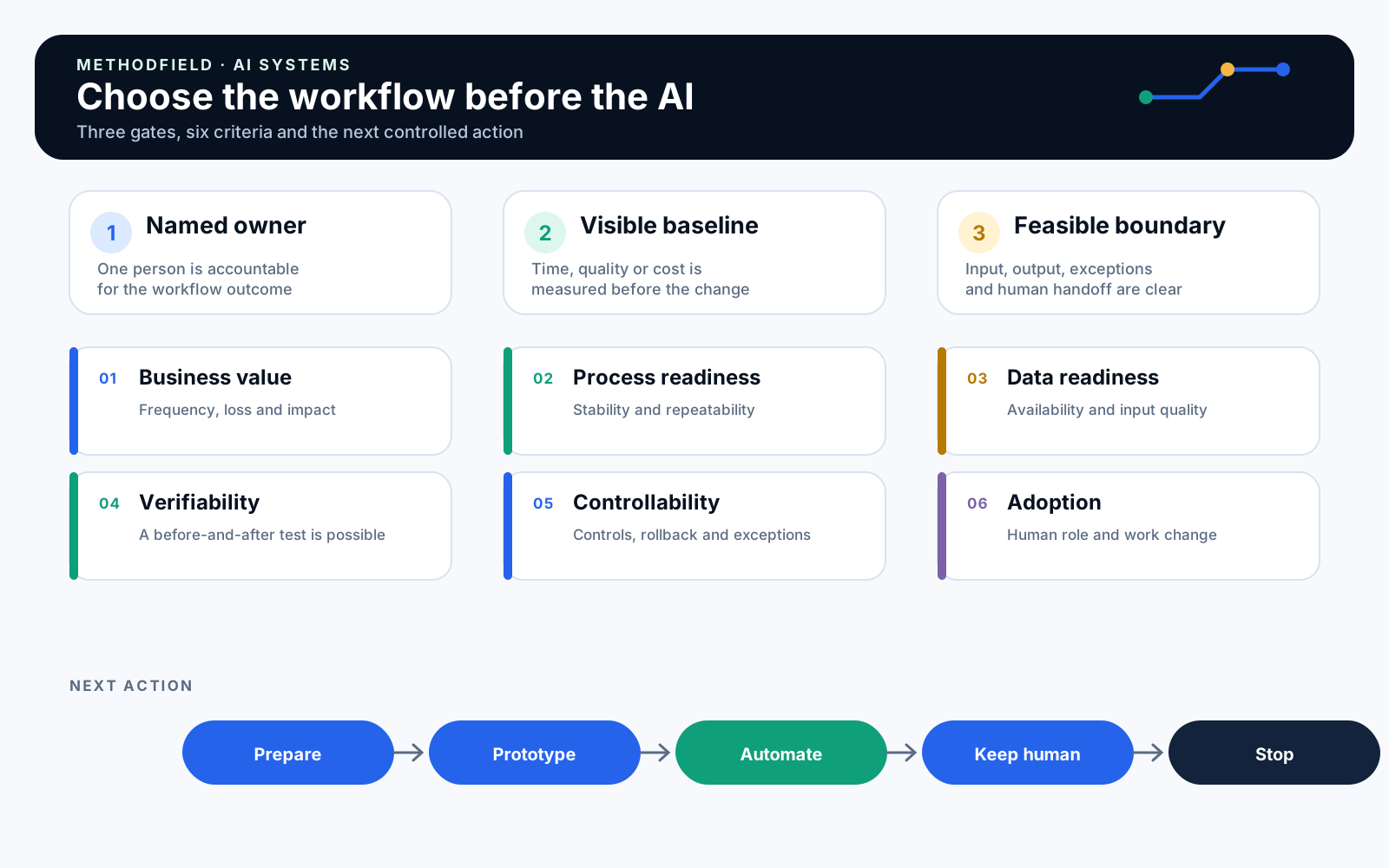
| Dimension | Low score | High score |
|---|---|---|
| Business value | minor inconvenience with little volume or consequence | frequent bottleneck tied to a meaningful operational result |
| Process readiness | unclear sequence, unstable rules and many hidden workarounds | visible flow, known exceptions and a named owner |
| Data readiness | examples are unavailable, unrepresentative or inaccessible | representative inputs and expected outputs can be reviewed safely |
| Verifiability | quality is subjective and no review rubric exists | the result can be checked by rules, references, a rubric or final-state evidence |
| Controllability | errors are hard to detect or reverse | permissions, approvals, escalation and fallback can contain errors |
| Adoption readiness | users have no reason or capacity to change their work | users are involved and the new action fits the operating rhythm |
Record confidence beside every score. “Data readiness: 4, low confidence” is a different decision from “Data readiness: 4, verified on 200 representative cases.”
Do not hide a failed gate inside a high total. A high-value idea with no owner or no legal path is not prototype-ready.
A synthetic comparison
Consider a small company serving customers in several languages. It is choosing between three ideas.
Candidate A: enquiry triage and draft response
The company already receives repeated enquiries through email and forms. Employees manually extract the service, date, location and missing details. The system would prepare a structured record and a response draft; an employee would approve price, promise and exception.
This candidate is likely to score well when the company has a message history, a clear service catalogue and measurable response times. The output is reviewable and the permission boundary is narrow.
Candidate B: a general customer chatbot
The idea is visible, but the intended outcome is unclear. Is it expected to reduce support volume, increase conversion, provide 24-hour availability or collect better enquiries? Each objective needs different knowledge, metrics and controls.
This candidate should return to problem definition before architecture is chosen.
Candidate C: autonomous discount decisions
The potential value may be high, but so are the consequences. The company must define pricing authority, customer fairness, margin boundaries, monitoring and recovery before the system can act. A decision-support prototype may be appropriate even when autonomous execution is not.
The comparison illustrates why value alone is insufficient. Readiness, verifiability and controllability determine what can be learned safely.
Choose the next action, not only a rank
Each candidate should end in one of five decisions.
Prepare the process
Use this when the problem is valuable but the workflow is unstable, data is inaccessible or ownership is unclear.
The next action may be process mapping, data cleanup, a quality rubric or an integration check. AI is not yet the constraint.
Run a bounded prototype
Use this when the central uncertainty can be tested with representative examples without granting production authority.
The prototype should answer a specific question, such as:
Can the system identify missing enquiry details with an agreed level of quality and show the evidence needed for employee review?
Use ordinary automation
Use this when inputs, rules and sequence are stable. A deterministic workflow will often be cheaper, faster and easier to verify.
The guide Does This Process Need an AI Agent? helps choose between rules, assistance and bounded autonomy after the workflow has been prioritised.
Keep the work human
Use this when the volume is low, judgment is central, context cannot be made available safely or the cost of a wrong action exceeds the likely benefit.
This is a design decision, not a failure to innovate.
Stop the idea
Stop when no meaningful outcome, owner or learning question can be identified. The organisation can reconsider the opportunity if the process or evidence changes.
What a workflow review should produce
A useful review creates a small decision package:
- Current workflow and owner.
- Bottleneck and baseline.
- Candidate intervention.
- Representative examples.
- Expected benefit and possible harm.
- Human-control boundary.
- Prototype question.
- Success, stop and escalation criteria.
- Expected operating cost and maintenance responsibility.
Only then should the team select the type of intelligence and authority. The guide Not Every AI Automation Needs an LLM provides the next decision frame.
Common prioritisation mistakes
- ranking technologies instead of workflows;
- treating executive interest as evidence of operational value;
- scoring value without scoring the ability to verify the result;
- assuming available data is representative data;
- ignoring the effort required from reviewers and process owners;
- using one composite score to conceal a failed safety or ownership gate;
- selecting a project because a vendor has a similar case;
- measuring activity, such as messages generated, instead of completed and verified outcomes.
Final position
The best first AI project is not necessarily the project with the largest theoretical upside. It is the project that can produce useful evidence about a real workflow while keeping the consequences controlled.
Prioritise the problem. Make the baseline visible. Test the uncertain part. Choose the smallest system that can improve the result.
Sources
- NIST, AI Risk Management Framework Core (opens in a new tab), version available on 26 August 2026.
- NIST, AI RMF Playbook (opens in a new tab), updated 10 June 2026.
- HM Treasury and Evaluation Task Force, Guidance on the Impact Evaluation of AI Interventions (opens in a new tab), updated 15 May 2026.
- ISO, ISO/IEC 42001:2023 — AI management systems (opens in a new tab), version available on 26 August 2026.