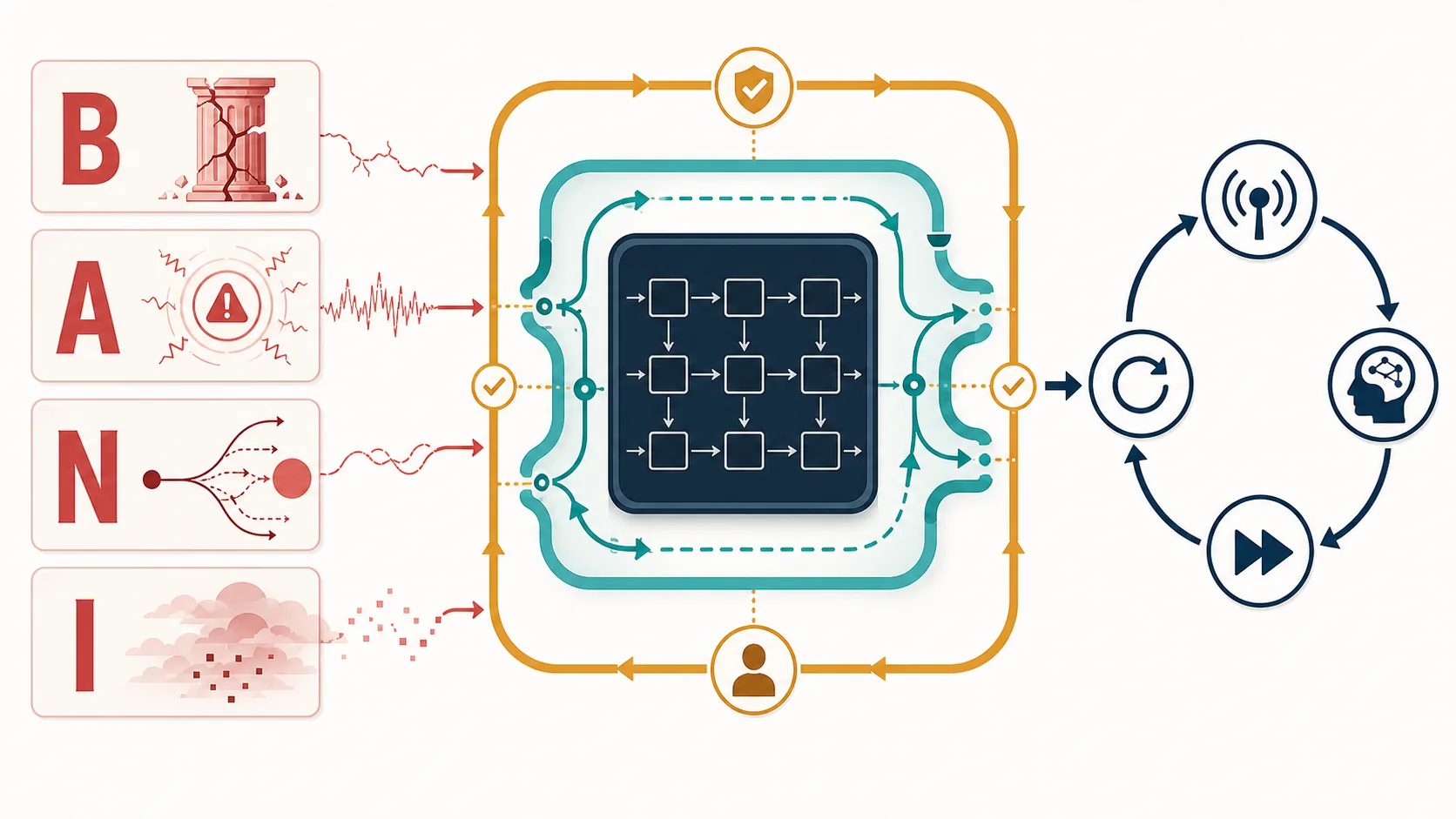
Diagram key: BANI pressures → stable core → adaptive AI layer → control gates → measurable outcome and feedback.
A company can be highly automated and still be brittle. Rules execute quickly, data moves between systems without manual entry and the team operates at peak efficiency—until a new request format, a supplier failure or an unfamiliar exception stops the workflow.
The BANI framework helps describe this problem. BANI stands for brittle, anxious, nonlinear and incomprehensible. For a business, it is neither a forecast nor a complete strategy. It is a diagnostic language: where might the system fail suddenly, where might information overload paralyse a decision, where could a small signal create a large effect, and where can nobody explain the result?
Methodfield's central position is:
In an unstable environment, advantage comes not from automating the largest number of steps, but from shortening the time required to adapt a process safely.
AI can shorten the path from a new signal to a changed way of working. Without a stable core, measurable quality and a person's authority to stop an action, however, it can create new brittleness faster than it removes the old kind.
BANI is a diagnostic framework, not a theory of the future
Futurist Jamais Cascio began developing BANI in 2018 and described it in detail in his 2020 essay Facing the Age of Chaos. He presented it as a complement to the language of VUCA: not merely to call an environment volatile and complex, but to see how chaos appears in systems and human behaviour.
Each dimension has an operational meaning.
| Dimension | What appears in a business | Useful response | How AI can help | How AI can make it worse |
|---|---|---|---|---|
| Brittle | the process works until the first unusual case | redundancy, modularity and a manual mode | detect anomalies and route a case through an alternative path | create dependence on one model or platform |
| Anxious | too many signals, conflicting data and fear of error | clear priorities and responsibility boundaries | summarise context, reduce noise and prepare a decision | generate confident misinformation and more alerts |
| Nonlinear | a small change causes a large cascade or the effect arrives late | small experiments and limits on the blast radius of error | identify weak signals and compare scenarios | mistake correlation for cause and scale the wrong action |
| Incomprehensible | data is abundant but the reason for a decision cannot be reconstructed | traceability, sources and expert review | compare documents and explain the context used | add an opaque model to an already opaque process |
BANI does not prove that every process needs to become more “intelligent”. The best response to instability may be to remove a redundant step, add a second supplier or document a rule that previously existed only in a specialist's head.
Why rigid automation can become a constraint
Conventional automation is indispensable when the event, rule and result are defined: if payment is received, update the status; if a required field is empty, stop the application; if the amount exceeds a limit, request approval.
The difficulty starts when the context changes:
- a customer describes a familiar need in a new way;
- a document arrives in an unexpected format;
- the old rule is followed correctly but produces a poor business result;
- an exception does not resemble anything the team has seen;
- changing the process takes weeks while demand changes in a day.
AI is useful in this variable part. It can interpret text, compare a case with approved knowledge, classify an exception, prepare a reviewable draft or propose the next route. It should not replace rules where an exact, reproducible result is required.
An architecture for flexibility: core, adaptive layer and governance
Reliable AI automation separates three responsibilities.
1. A stable deterministic core
Conventional software and workflows handle access rights, amounts, required fields, transactions, statuses, deadlines and strict prohibitions. This part should treat identical inputs identically and must not depend on a model's wording.
2. An adaptive AI layer
AI operates where inputs vary and a requirement can be expressed in language. It classifies an email, extracts details, finds supporting evidence, compares options, prepares a summary or recommends an action. Its output remains probabilistic even when it sounds certain.
3. A governance and feedback loop
Policy determines which output may be accepted automatically, which requires approval and when the workflow must switch to manual operation. The system records the input, sources used, model version, human decision and observed outcome. An error then becomes evidence for improving a rule, the data or the model.
This structure separates the ability to interpret from the authority to act. The companion guide, From observation to action, explains how that authority can grow safely.
What operational evidence shows
Public cases do not prove that AI will be universally effective, and they are not Methodfield client results. They illustrate recurring architecture patterns. The figures below were reported by the companies or their technology providers and need to be validated in every new context.
C.H. Robinson: adaptation around a stable operation
The logistics company used AI to read incoming freight requests and prepare a quote inside its existing operational process. In a Microsoft case study, the company reported reducing quote preparation from hours to 32 seconds and a path towards a 15% productivity increase.
The percentage is not the main lesson. The variable input—emails and documents—is interpreted adaptively, while calculation and downstream execution remain in controlled systems.
BBVA: scale requires a shared governance layer
BBVA expanded corporate AI assistants through a platform, training and the exchange of reviewed solutions rather than as unrelated experiments. In an OpenAI case study, the bank reported saving around three hours per employee each week; the effect varied across use cases.
A small business operates at another scale, but the principle still applies. If every employee creates an automation without an owner, approved sources or quality measurement, the company gains more versions of the process—not more flexibility.
Google: autonomy followed recommendations
Google's data-centre cooling system first provided recommendations to operators. Only after operating experience did it begin to control equipment directly. Actions were checked against cloud and local safety constraints, while operators retained control of the operating boundaries.
This case is especially relevant to BANI. Adaptability did not come from removing control, but from combining a model with independent safety rules and a reversible operating mode.
Vodafone: value is measured through recovery
In an investor presentation, Vodafone reported a 43% reduction in mean time to repair through predictive network analytics. This is a company-reported result without a public breakdown of the separate contributions from AI and operational change.
The choice of metric is still instructive. Resilience is better measured not by the number of predictions but by how quickly the operation identifies a problem and returns to normal.
What transfers to a small business
A small business does not need the infrastructure of a global bank or an industrial company. What transfers is the design approach, not the scale of the solution.
- Select one variable workflow. Start with incoming enquiries, proposal preparation or document handling—not “automating the whole company”.
- Define the stable core. Prices, commitments, payments, permissions and legally significant actions remain deterministic.
- Give AI one reviewable role. Extract requirements, find a contradiction, suggest a category or prepare a draft.
- Show the result to a person first. Corrections reveal real exceptions and quality criteria.
- Record the outcome, not only the model output. Was the request accepted? Was rework required? How long did it take? Did a complaint follow?
- Design a manual mode. An unavailable API or a low-confidence output must not stop customer service.
Measure the ability to adapt
Time saved still matters, but it is not enough for flexible automation. A useful measurement system includes:
- time from a new case type to a supported response;
- length of the hypothesis–test–change cycle;
- share of cases escalated to a person;
- rate at which people override recommendations;
- repeated errors and rework;
- recovery time after failure;
- share of answers with verifiable sources;
- cost per confirmed outcome.
The combined measure is time-to-adapt: the time between detecting a change and operating the updated workflow reliably. It must not be reduced by accepting more critical errors.
When AI will not add flexibility
Do not begin an AI project when:
- nobody owns the process outcome;
- the team cannot distinguish a good result from a bad one;
- examples are scarce and one error would be irreversible;
- one rule or the removal of one step would solve the problem;
- approved, current sources are unavailable;
- an action cannot be stopped or rolled back safely.
In these situations, AI hides organisational debt. A defined process, usable data and clear responsibility come first.
Final position
AI does not remove BANI. It can shorten the path from signal to adaptation—or become another opaque dependency.
Practical advantage appears when an organisation combines:
- stable rules for what is known;
- AI for interpreting variable inputs;
- control gates for external actions;
- feedback from actual outcomes;
- a person with real authority to intervene;
- a fallback way to continue operating.
The objective is not autonomy for its own sake. It is a workflow that can change safely faster than its environment changes.
Sources
- Jamais Cascio, Facing the Age of Chaos (opens in a new tab), 29 April 2020.
- Jamais Cascio, Human Responses to a BANI World (opens in a new tab), 2022 talk published 25 January 2023.
- NIST, AI Risk Management Framework (opens in a new tab), version reviewed 31 July 2026.
- OECD.AI, Principles for trustworthy AI (opens in a new tab), version reviewed 31 July 2026.
- Microsoft, C.H. Robinson customer story (opens in a new tab), version reviewed 31 July 2026.
- OpenAI, BBVA customer story (opens in a new tab), version reviewed 31 July 2026.
- Google DeepMind, Safety-first AI for autonomous data centre cooling and industrial control (opens in a new tab), 17 August 2018.
- Vodafone, H1 FY26 presentation (opens in a new tab), version reviewed 31 July 2026.